
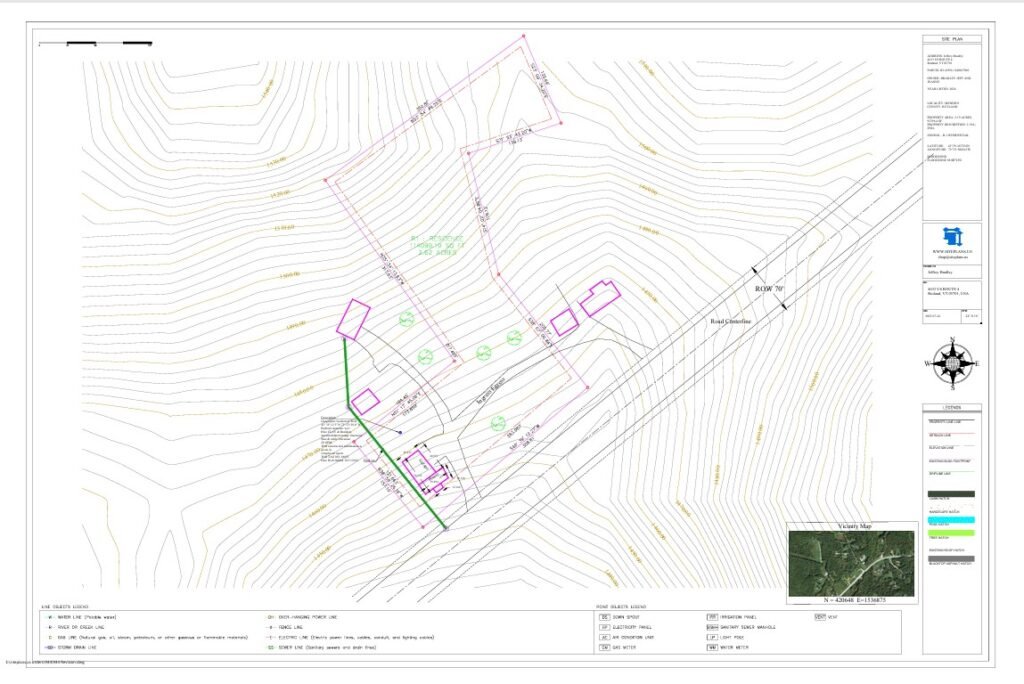
$89. Your fence site plan tomorrow. Free revisions if it comes back.
Most homeowners don’t expect a fence permit to be complicated. It’s a fence. Posts in the ground, boards or wire between them, done in a day.
Then the correction letter arrives: “Property line location not verified. Fence shown inside easement boundary. Front yard height exceeds district maximum of 4 feet.”
The installer moves to the next job. The materials sit. The permit queue restarts.
Fence permits generate correction comments at a higher rate than their simplicity suggests — not because fences are hard to permit, but because the three things reviewers check are the three things most homeowners get wrong: where the property line actually is, whether a utility easement runs along that line, and what the height limit is in the front yard versus the rear yard.
Those aren’t complicated problems. They’re research problems. We do the research before we draw the plan.
What Fence Permits Actually Review — And Where Plans Fall Apart
A fence permit application is not a structural review. The building department isn’t evaluating post depth or board spacing. They’re checking three things:
One — Is the fence on the right side of the property line?
This sounds obvious. It isn’t. The rear fence line that’s been there since the subdivision was built in 1978 may not be on the actual property line. It may be six inches inside. It may be eight inches outside. Neighbors adjust fence positions informally over decades. By the time a homeowner pulls a permit to replace or extend that fence, the assumed property line and the recorded property line may be meaningfully different.
A fence plan that shows the fence line and the property line as the same feature — without documenting them separately from recorded plat dimensions — produces a reviewer comment asking for clarification. A fence plan that places the fence outside the actual property line produces a comment asking for relocation.
We draw property lines from recorded plat dimensions and show the proposed fence line as a separate element with its offset from the boundary documented.
Two — Is there a utility easement along that property line?
The same 10-foot utility easement that runs along the rear property line of most subdivided residential lots is relevant to fence permits too. Unlike a shed or garage, a fence can often be built within or across a utility easement — but only if the fence type and installation method meet the utility company’s standards. Some easements prohibit any fence. Some allow open-style fencing but not solid wood panels. Some require gates wide enough for utility vehicle access.
A plan that shows a fence running through an easement without addressing the easement type and access requirements comes back. We pull easement references from county recorder records, note the easement type, and flag access width requirements where applicable.
Three — Does the fence height comply with district standards — front yard vs. rear yard?
This is where most fence permit applications fail. Fence height limits are almost universally split between front yard and rear/side yard standards. The rear yard allows 6 feet in most residential districts — sometimes up to 8. The front yard is typically capped at 3 or 4 feet. The side yard that runs from the front of the house to the rear setback line sits in a transition zone that some cities treat as front yard and others treat as rear yard depending on which side of the front building line it falls on.
A homeowner who wants a 6-foot privacy fence all the way around the property — front included — runs into the front yard height limit in virtually every US jurisdiction. Plans that show a uniform 6-foot fence from front to rear come back with a comment asking for the front section to be reduced or removed.
We verify front yard, rear yard, and side yard height limits for your zoning district and note them on the plan.
What Fence Permit Correction Letters Actually Say
“Property line location not documented from recorded plat. Fence line and property line shown as single element. Separate dimensions required. Resubmit with property line documented from legal plat and fence offset shown.”
Property line and fence line are two different things on a plan. We document both — property line from recorded plat dimensions, fence line as a proposed element with offset shown.
“Proposed fence located within 10-foot utility easement along rear property line. Easement type and access requirements must be addressed. Solid panel fencing may be prohibited. Utility company authorization or open-style fence design required. Resubmit.”
We pull the easement reference from county records, identify the easement type, and note access width requirements. If solid fencing is prohibited within the easement, we flag it before you order materials.
“Front yard fence height shown at 6 feet. Maximum front yard fence height in this district is 4 feet. Revise front yard section to comply or apply for variance. Resubmit.”
Front yard height limits catch more fence permit applications than any other single comment. We verify the limit for your district and show compliant heights in each yard zone.
“Fence shown on corner lot without sight triangle notation. Corner lots require visibility clearance triangle at intersection. Fence must be set back from sight triangle or height reduced within triangle. Resubmit.”
Corner lots have a sight triangle requirement — a visibility zone at the street intersection where fence height is restricted to protect driver sightlines. We identify corner lot conditions and note the sight triangle on the plan.
“Gate location not shown. Driveway access gate width must be documented. Minimum 10-foot clear width required for this property. Resubmit with gate locations and widths shown.”
Gates are part of the fence plan. We show gate locations, swing direction, and width — particularly where driveway access gates need to meet minimum clear width standards.
“Historic district fence standards not addressed. Property located within locally designated historic district. Fence material, style, and height require Certificate of Appropriateness prior to permit issuance. Application returned.”
Properties in historic districts have design standards for fences that go beyond height and location. We flag historic overlay conditions before the plan is drafted.
What Every Fence Site Plan We Deliver Includes
Simple project. Complete documentation. Here’s what goes on every shed plan we deliver:
| Element | Why It Matters to the Reviewer |
|---|---|
| Property lines from recorded plat dimensions | Separate from fence line — both documented independently |
| Proposed fence line with offset from property line | Fence location relative to boundary clearly shown |
| Front yard fence height — per district standard | Verified against zoning district front yard maximum |
| Rear and side yard fence height | Verified against rear/side yard maximums — often different from front |
| Transition zone height designation | Side yards ahead of the front building line treated correctly per local standard |
| Utility easements with instrument references | Type, width, location — pulled from county recorder records |
| Gate locations, swing direction, and width | Driveway gates and pedestrian gates shown with dimensions |
| Corner lot sight triangle notation | Visibility clearance zone identified and noted where applicable |
| Historic overlay acknowledgment | COA requirement flagged for properties in designated historic districts |
| Existing primary structure footprint | Reference point for setback and transition zone calculations |
| North arrow, engineering scale, legal description | Required on every submittal — missing any means rejection before review |
Fence Height Rules — How They Actually Work
The front yard vs. rear yard split is the rule. Here’s how it plays out across common residential zoning districts:
Standard residential district (most US cities):
- Front yard: 3–4 feet maximum
- Side yard (ahead of front building line): 3–4 feet, treated as front yard
- Side yard (behind front building line): 6 feet
- Rear yard: 6 feet
Some cities allow 8-foot rear yard fences in privacy-sensitive situations or on lots adjacent to commercial or industrial zones. We verify whether that option exists for your parcel.
Corner lots have two front yards in most jurisdictions — one facing each street. Both carry the front yard height limit.
Properties adjacent to arterial roads or highways sometimes have different fence standards — taller fences may be permitted on the arterial-facing side for noise or privacy mitigation.
HOA rules are separate from city fence standards and are often more restrictive. HOA approval and city permit approval are two different processes. We handle the city side.
Fence Permits Across the Cities We Know
Sacramento, CA — Front yard maximum typically 3 feet in residential districts. Rear yard 6 feet. Corner lot sight triangle required. Easements from Sacramento County recorder.
Jacksonville, FL — Front yard fence height varies by residential district — typically 4 feet. Rear yard 6 feet. Corner lot sight triangle per City of Jacksonville standards.
Raleigh, NC — Front yard maximum 4 feet in most residential districts. Rear yard 8 feet permitted in some districts. Historic district COA required in Oakwood, Boylan Heights, Mordecai, and other designated districts.
Austin, TX — Front yard fence height typically 4 feet. Rear yard 8 feet in some residential districts. Heritage tree root zone check required if fence post installation affects a 19″+ DBH tree’s critical root zone.
Dallas, TX — Front yard 4 feet. Rear yard 6–8 feet depending on district. Corner lot sight triangle required.
Phoenix, AZ — Front yard typically 3–4 feet. Rear yard 6 feet. Block wall fences common — height and setback requirements apply same as wood fencing. Corner lot sight triangle strictly enforced.
Pricing
| Plan | Price | Best For |
|---|---|---|
| Basic – $89 | Standard residential fence on a straightforward lot | Property lines, fence line, height zones, easements, gate locations, north arrow, scale |
| Enhanced – $159 | Corner lot, historic district, or easement-complex fence | Adds sight triangle notation, COA flag, easement type and access requirements |
✅ Free revisions on any correction comments
✅ 24-hour turnaround
✅ All 50 states
✅ No survey required for most fence permits
FAQs — Fence Permit Site Plans
In most US jurisdictions, yes — for any fence over a certain height, typically 3 or 4 feet, or for any fence that encloses a pool. Some cities require permits for all fences regardless of height. Others exempt fences below a specific height on interior lots. We verify your city’s threshold before you order. If your fence falls below the permit requirement, we’ll tell you upfront.
From a neighbor relations standpoint, yes. From a permit standpoint, no. Building departments don’t accept neighbor agreements as documentation of property line location. The plan must show the property line from recorded plat dimensions and the proposed fence line as a separate element. If the agreed fence location doesn’t match the recorded property line, that discrepancy needs to be addressed before the permit is issued.
Almost certainly not. Front yard fence height limits are almost universally capped at 3 or 4 feet in US residential zoning districts. A 6-foot front yard fence requires a variance in most cities. We verify the limit for your district and note it on the plan. If you’re hoping for 6 feet in the front, we’ll tell you what’s possible and what requires a variance before you submit anything.
Yes, significantly. Corner lots have two street-facing frontages, both of which typically carry the front yard fence height restriction. The portion of the lot that qualifies for the taller rear yard fence is smaller than on a standard interior lot. Corner lots also require a sight triangle at the intersection — a visibility clearance zone where fence height is restricted to protect driver sightlines. We identify corner lot conditions and show the sight triangle on the plan.
It may be. The answer depends on the easement type and the fence design. Some utility easements allow open-style fencing — chain link, split rail — but prohibit solid panels. Others require a gate wide enough for utility vehicle access. Some prohibit fencing entirely. We pull the easement reference from county records and identify which restrictions apply before the plan is drafted.
Yes, but the fence design needs to meet the historic district’s standards for materials, style, and height — which are separate from and sometimes more restrictive than general zoning standards. You’ll need a Certificate of Appropriateness from the historic review body before the building permit application is accepted. We note the COA requirement on the plan. The COA application itself is a separate process you’ll need to pursue with the historic commission.
Other Site Plans We Deliver
Pool Site Plan for Permits We've Worked Across These Cities
ADU rules are local. Every order includes jurisdiction-specific research — not a static template