
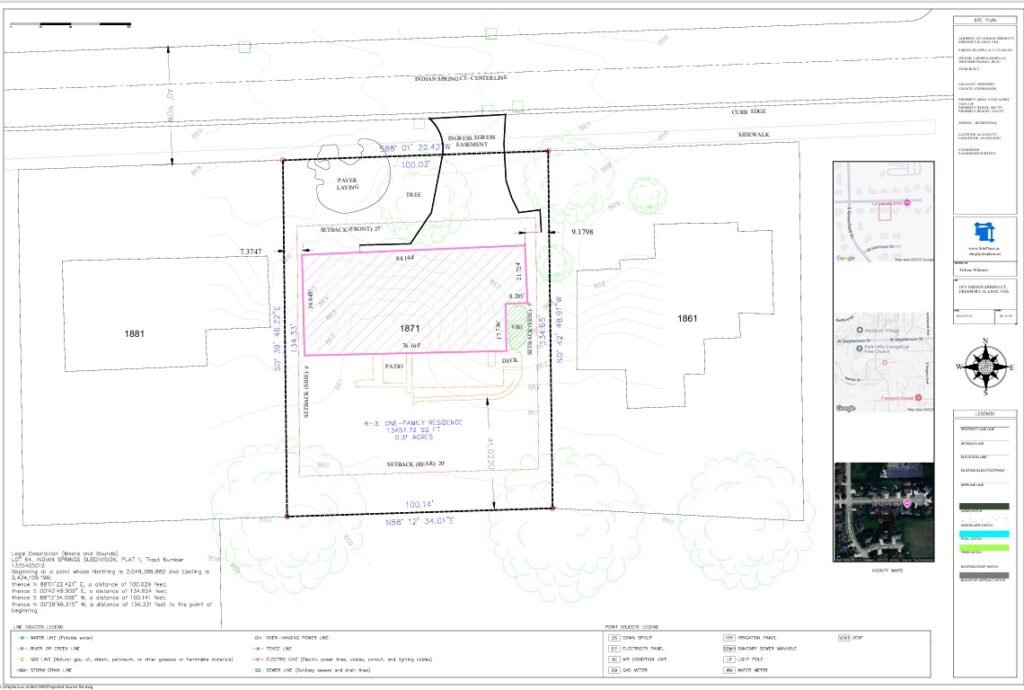
You're filling out a permit application. It says "site plan required." You've never needed one before. You're not sure where to get it, what it needs to show, or how long it takes.
Here’s the direct answer — and the part most guides leave out.
The Short Answer
You have four options for getting a site plan. One of them is fast, affordable, and built specifically for permit submissions. The other three are slower, more expensive, less targeted to what a permit reviewer actually needs, or all three.
Option 1 — Order from a professional permit drafting service (us) A done-for-you service that researches your parcel, drafts the plan to your city’s submittal requirements, and delivers a PDF in 24 hours. Starts at $89. This is what most homeowners pulling a residential permit need.
Option 2 — Hire a local architect or draftsman A local professional can produce a site plan — but site plans are typically a small part of what architects do, and the hourly rate reflects that. Expect $200–$600 for a basic residential site plan, a 1–2 week turnaround, and a plan that may or may not be formatted to your city’s specific permit checklist.
Option 3 — Hire a licensed land surveyor Surveyors produce certified boundary documents. If your permit checklist explicitly requires a “certified site plan” or “survey,” this is the path. For standard residential permits — garage, ADU, pool, addition, shed, fence — the checklist usually doesn’t require a surveyor stamp. A survey costs $400–$1,500 and takes 2–4 weeks. If you don’t need certification, this is expensive and slow for no added permit benefit.
Option 4 — Draw it yourself Possible in some jurisdictions for very simple projects. Most homeowners who try this produce a plan that’s missing something — a flood zone note, a correct setback measurement, an easement reference — and get it back in a correction letter. The time spent learning what the plan needs to include, drafting it, and then revising after correction typically exceeds the cost of ordering a professional plan in the first place.
What Option Is Right for Your Situation
| Your Situation | Best Option |
|---|---|
| Standard residential permit — garage, ADU, pool, addition, shed, fence, deck | Professional drafting service — $89 T o 249$ , 24 hours |
| Permit checklist explicitly says “certified” or “survey required” | Licensed land surveyor |
| Large custom home, commercial project, or complex engineering involved | Local architect or engineer |
| Boundary dispute or mortgage survey requirement | Licensed land surveyor |
| Simple structure, confident in local zoning rules, time available | DIY — but verify requirements first |
What a Site Plan for a Permit Needs to Show
This is where DIY attempts most commonly fail — and where a service that doesn’t know your city’s checklist produces a plan that comes back for corrections.
Every residential permit site plan needs these core elements:
Property lines — From recorded plat dimensions, not GIS approximations. Reviewers compare submitted plans against the recorded plat. Rounded GIS coordinates fail that comparison on smaller lots.
Existing structures — The house, any existing garage or accessory structures, and any existing hardscape that contributes to lot coverage.
Proposed structure — What you’re building, drawn to scale, with all dimensions shown.
Setback dimensions — Distance from the proposed structure to every property line, measured to the furthest projection of the structure. Not the foundation wall. The eave, overhang, or furthest element.
Lot coverage calculation — All impervious surfaces on the lot expressed as a percentage of total lot area. House, proposed structure, driveway, patio, deck, and walkways — all of it, not just the new construction.
North arrow and engineering scale — Required on every permit submittal without exception.
Legal description and parcel number — Required for the reviewer to match the plan to the correct parcel record.
Beyond these core elements, your city adds its own requirements:
- Flood zone designation and FEMA panel number — Required in flood-mapped areas and in many cities even outside AE zones
- Tree protection notation — Required in cities with active tree ordinances when protected species are present
- Riparian buffer extents — Required on parcels near regulated streams in cities like Raleigh
- ADU size and height verification — Required when the project includes an accessory dwelling unit
- Easements with recorded instrument references — Required when easements appear on the parcel
- Base Flood Elevation and proposed finished floor elevation — Required in Jacksonville, coastal cities, and other flood-active markets
A plan missing any of these generates a correction comment. A correction comment adds a resubmission cycle. A resubmission cycle typically adds 10 to 30 business days depending on the city.
How to Know What Your Specific City Requires
The fastest way: look up your city’s building permit application checklist online. Most US building departments publish their residential permit submittal requirements on their website. Search for “[your city] building permit application” or “[your city] site plan requirements.”
What you’re looking for: a checklist that lists every document required for your permit type. The site plan line item will either say “site plan” (non-certified acceptable) or “survey” / “certified site plan” (licensed stamp required).
If the checklist isn’t clear, call the building department’s public counter before you order anything. Ask: “For a [project type] permit, do you require a certified site plan or will a professionally drafted non-certified plan be accepted?” Most counter staff will give you a direct answer.
Alternatively — enter your address and project type at checkout. We verify the requirement for your city as part of the drafting process. If your project requires a certified plan, we’ll tell you before your order is processed.
How Long Does It Take to Get a Site Plan?
| Source | Typical Turnaround | Cost Range |
|---|---|---|
| Professional permit drafting service | 24 hours | $89–$249 |
| Local architect or draftsman | 1–2 weeks | $200–$600 |
| Licensed land surveyor | 2–4 weeks | $400–$1,500 |
| DIY | Days to weeks (plus revision time) | Free — but often costs more in time |
For most homeowners with a permit to pull, 24 hours matters. Contractors have schedules. Project windows open and close. A permit that takes three weeks longer than it needed to because the site plan was slow to arrive or came back for corrections is a real cost — in time, in contractor availability, and sometimes in material price changes.
Can I Get a Site Plan for Free?
Some county GIS portals and city planning websites provide parcel maps that show property boundaries and existing structures. These can give you a starting point — but they’re not permit-ready documents.
The gaps: GIS data uses rounded coordinates that may differ from recorded plat dimensions. GIS maps don’t show setback dimensions, lot coverage calculations, flood zone notes, tree protection requirements, or any of the city-specific annotations that keep a plan out of the correction queue.
A GIS parcel map tells you what’s on the lot. A permit site plan tells the reviewer that what you’re proposing complies with zoning — and does it in the format, at the scale, and with the specific notation that reviewer’s checklist requires.
They’re related documents. They’re not the same document.
Where We Fit In
We’re a done-for-you permit drafting service. You provide the address and project type. We pull your parcel records from the county recorder, verify your zoning district and applicable setbacks, check your flood zone status, identify any tree or environmental overlay requirements, and draft a plan to your city’s specific submittal format.
You get a PDF in 24 hours that’s built to pass review — not a template with your address dropped in.
$89 for standard residential projects. $249 for ADUs and complex parcels. Free revisions if the city sends correction comments.
✅ Free revisions on any correction comments
✅ 24-hour turnaround on most pool permit projects
✅ All 50 states — jurisdiction-specific research on every order
✅ No survey required for the majority of pool permits
What to Do Right Now
If you have a permit application in front of you that says “site plan required”:
- Check the checklist — does it say “certified” or “survey required”? If not, a non-certified professional plan will work.
- Identify your project type — garage, ADU, pool, addition, shed, deck, fence, or other.
- Order the plan — enter your address and project type at checkout. We do the rest.
- Submit to your permit portal with the PDF we deliver — typically within 24 hours.
The permit queue starts the day you submit a complete application. Every day spent figuring out the site plan is a day the permit queue isn’t running.
FAQs
Some contractors handle the full permit process including the site plan. Many don’t — they pull the permit but expect the homeowner to provide the site plan separately. Confirm with your contractor whether the site plan is included in their service. If it’s not, we can turn it around in 24 hours so it doesn’t hold up their permit application.
Sometimes. A like-for-like replacement — same footprint, same location, same use — may not require a new site plan in some jurisdictions. But if the structure has changed size, moved location, or if the permit type changed, a site plan is typically required. Call your building department’s counter to confirm before assuming you’re exempt.
Most counties — rural and urban — require site plans for permitted structures. Some rural counties have simplified requirements for agricultural structures. For residential projects — houses, garages, ADUs — the site plan requirement typically applies regardless of whether you’re in a city or an unincorporated county area. We cover all 50 states including rural county jurisdictions.
PDF is accepted by virtually all US permit portals for digital submission. Plans must be drawn to an engineering scale — typically 1″=20′, 1″=30′, or 1″=40′ depending on lot size — with a scale bar shown. We deliver in PDF at the correct engineering scale for your parcel. If your city has a specific page size requirement (24×36, 11×17), we match it.
Yes. Send us the rejection or correction letter from your building department. We’ll review every comment, address each one in the revised plan, and return it typically within 24 hours. If the plan came from us originally, there’s no additional charge.
Search “[your city] building permit portal” or “[your city] online permit application.” Most US cities now accept digital permit submissions through online portals — Accela, OpenGov, eTRAKiT, and similar platforms are the most common. We can point you to the right portal for your city when we deliver your plan.
Answers for Specific Projects
Pool Site Plan for Permits We've Worked Across These Cities
Site Plan for Permit City rules are local. Every order includes jurisdiction-specific research — not a static template