
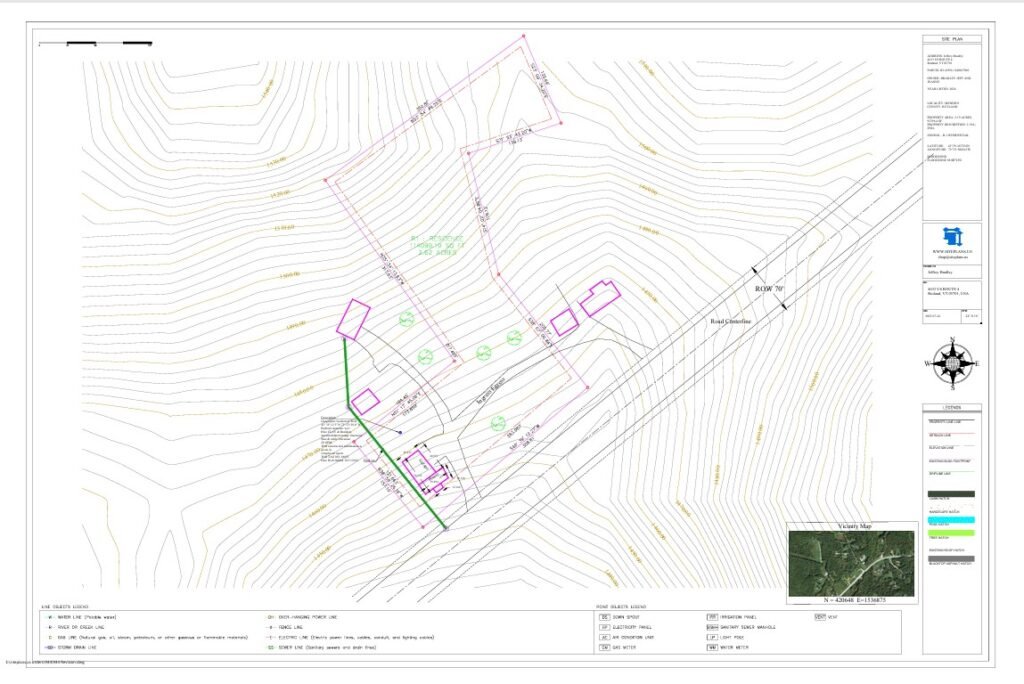
An ADU permit application has more moving parts than any other residential project. Size cap. Height limit. Lot coverage calculation. Setback standard that may differ from your primary structure's. State preemption rules that override what the city ordinance says — or don't. Get one number wrong and it comes back.
Most site plan rejections on ADU projects aren’t structural problems. They’re measurement problems. The proposed footprint is 40 square feet over the local size cap. The height was calculated from finish floor instead of natural grade. The lot coverage math didn’t include the existing driveway. The setback was pulled from the wrong section of the zoning code.
None of those require a redesign. They require a drafter who read the right ordinance before drawing the first line.
We draft ADU site plans starting from your city’s current ADU standards — size limits, height caps, setback rules, lot coverage thresholds, and any state preemption provisions that change what the local code allows. The plan that goes to your building department reflects what that department’s reviewer is actually checking.
$89 for basic projects. $249 for ADUs with full compliance verification. Delivered within 24 hours. Free revisions on any correction comments.
Why ADU Permits Get Rejected More Than Any Other Residential Project
ADUs sit at the intersection of local zoning codes, state housing legislation, and building department submittal requirements — three layers that don’t always agree with each other.
In California, state law sets a floor: cities cannot cap a one-bedroom ADU below 850 square feet or a two-bedroom below 1,000 square feet, and detached ADUs must be allowed up to 1,200 square feet under state standards regardless of local ordinance. But local cities still apply objective standards on height, setbacks, and architectural review within those floors. A plan drafted to the state minimum without checking the local overlay may still come back for a city-specific note that wasn’t included.
In Texas, ADU rules remain almost entirely local. Dallas caps accessory dwelling units differently than Austin, which applies watershed-specific impervious cover limits that can effectively constrain an ADU footprint on certain lots regardless of what the zoning district otherwise allows.
In North Carolina, Raleigh’s UDO Section 2.6.3.D governs ADUs separately from general accessory structure standards. The size cap is whichever is smaller — 750 square feet or 25% of the primary structure’s floor area. A 3,200 square foot primary home generates an 800 square foot figure under the 25% rule, but the absolute cap overrides it at 750. Plans submitted at 780 square feet come back.
In Florida, Jacksonville measures the ADU cap the same way — 750 square feet or 25% of the primary structure — and applies it before BID begins structural review. No calculation shown on the plan means an automatic comment before the file is opened.
Across all of these cities, the same categories of information appear on correction letters:
- ADU size not verified against local cap
- Height calculated from wrong reference point
- Lot coverage calculation missing or incomplete
- Setback standard applied from wrong zoning section
- State preemption provisions not addressed
- Utility connection points not shown
- Owner-occupancy notation absent where required
We check all of these before the plan leaves our desk.
ADU Types — What Each One Requires on the Site Plan
Detached ADU The most common type and the most heavily regulated. The site plan must show the ADU footprint with dimensions, all setback distances from property lines, lot coverage calculation including both structures, height noted and verified against the local cap, and utility connections. In cities with active tree ordinances, any protected tree within the disturbance area must also appear. Detached ADUs trigger the most city-specific research of any residential project type.
Attached ADU Shares a wall with the primary structure. The site plan shows the combined footprint, the connection point between units, and the exterior entrance location. Size limits for attached ADUs in many jurisdictions are tied to a percentage of the primary structure — typically 50% — which requires the primary structure square footage to be documented on the plan.
Garage Conversion ADU Converts an existing detached garage into a habitable unit. The existing garage footprint is already on the property — the site plan documents the conversion, any exterior modifications, new utility connections, and whether replacement parking is required under the local ordinance. Some cities waive parking requirements for garage conversions; others don’t. We verify which rule applies to your parcel.
Basement or Interior Conversion (JADU) Junior Accessory Dwelling Units are typically carved from existing interior space. The site plan documents the exterior entrance location, the relationship of the JADU to the primary structure, and any exterior modifications. Floor plans are a separate document — the site plan establishes the site context and zoning compliance.
Two-Story Detached ADU Height calculation is the primary complexity here. Most jurisdictions measure ADU height from natural or pre-existing grade to the midpoint of the roof. Some measure to the ridge. Some measure from finished floor. The local standard determines whether a two-story ADU at 18 feet clears the height cap or triggers a comment. We identify the correct measurement method for your city before calculating.
Garage-Top ADU (Above Garage) Permitted in some jurisdictions, prohibited or restricted in others. Where allowed, the combined structure height — garage plus habitable space above — is measured against the ADU height cap. We verify whether your city permits this configuration and what the combined height calculation shows.
Every plan we deliver includes all of the above, plus the city-specific items your jurisdiction requires.
What Your ADU Site Plan Must Include
No two cities have identical ADU checklists. But every approvable ADU site plan contains a core set of elements that reviewers check across all jurisdictions:
| Element | Why Reviewers Check It |
|---|---|
| ADU footprint with dimensions | Size cap compliance — verified against local ordinance and state preemption floor where applicable |
| Primary structure footprint | Required for percentage-based size calculations and combined lot coverage |
| All setback distances | ADU setbacks often differ from primary structure standards — we pull the correct section |
| Lot coverage calculation | Combined footprint of all structures, driveways, and hardscape as a percentage of lot area |
| ADU height notation | Measured from the correct reference point per your city’s method — grade, FFE, or other |
| Exterior entrance location | Required for all ADU types; separate entrance documentation for JADUs |
| Utility connections | Water, sewer, and electric connections shown — separate service vs. shared service noted |
| Parking notation | Replacement parking shown where required; waiver noted where applicable |
| Property lines from recorded plat | Legal dimensions, not GIS coordinates — reviewers compare against recorded documents |
| North arrow, engineering scale, legal description | Missing any of these means rejection before substantive review begins |
| City-specific notes | Tree protection, flood zone, riparian buffer, state preemption language — added per jurisdiction |
Pricing — ADU Site Plans
| Plan | Price | Best For |
|---|---|---|
| Basic – $89 | Simple ADU footprint on straightforward lot | Property lines, ADU and primary footprints, setbacks, lot coverage, north arrow, scale — for jurisdictions with minimal complexity |
| Enhanced – $149 | ADU with environmental, flood, or tree factors | Adds flood zone data, tree protection notation, riparian buffer extents, easement references, utility connections, impervious line items |
| Premium – $249+ | Full ADU compliance verification | Adds state preemption analysis, ADU ordinance research, size cap verification, height calculation confirmation, historic overlay notation, complex lot geometry, grading notes |
✅ Free revisions on any correction comments
✅ 24-hour turnaround on most ADU projects
✅ All 50 states — jurisdiction-specific research on every order
✅ No survey required for the majority of ADU permit applications
✅ Free revisions on any city correction comments
✅ 24-hour delivery for standard residential projects
✅ Accepted by building departments in all 50 states
✅ No site visit, no survey required for most projects
ADU Size Caps by City — What We Verify Before Drawing
ADU size limits are the single most common source of first-cycle correction comments on ADU permit applications. Here’s what the rules look like across the cities we work in most frequently:
| City | Detached ADU Cap | Key Local Variable |
|---|---|---|
| Sacramento, CA | 800 sq ft (state min: 850 sq ft 1BR / 1,000 sq ft 2BR) | 25 ft height near transit corridors; 16 ft standard |
| Los Angeles, CA | 1,200 sq ft (state standard) | Local objective standards still apply; check zoning district |
| Jacksonville, FL | Lesser of 750 sq ft or 25% of primary structure | BFE + FFE required before BID review opens |
| Raleigh, NC | Lesser of 750 sq ft or 25% of primary structure | Impervious line items; Neuse buffer if stream present |
| Austin, TX | Determined by impervious cover limit for watershed zone | Heritage tree (19″+ DBH) review required if tree affected |
| Dallas, TX | Varies by zoning district | Lot coverage and impervious tracked separately |
| Atlanta, GA | 750 sq ft; FAR cap 50% of lot area combined | Floor Area Ratio applies to combined structure total |
| Portland, OR | 800 sq ft or 75% of primary structure, whichever is less | 20 ft height outside setbacks; 15 ft inside setbacks |
| Denver, CO | 1,000 sq ft or 50% of primary structure | State HB24-1152 requires by-right ADU in most jurisdictions |
| Charlotte, NC | Varies by zoning district | MHA overlay may apply; lot coverage check required |
Local ordinances change. We verify your city’s current standard at the time of every order — not from a static table.
The State Preemption Layer — Why Your City's Ordinance Isn't the Whole Story
In California, state law limits how restrictive local ADU rules can be. A city ordinance that caps ADUs below the state minimums is preempted — the state floor applies instead. This means a homeowner in Sacramento with a lot where the local ordinance would otherwise restrict the ADU to 650 square feet may still be entitled to build up to 850 square feet under state law.
In Colorado, HB24-1152 requires most municipalities with a population above 1,000 in a metropolitan planning organization to allow at least one ADU by-right on any single-family lot. Local jurisdictions had to comply by June 2025.
In Massachusetts, the 2024 Affordable Homes Act established a state-level ADU framework that limits how restrictive local dimensional standards can be — the most permissive setback standard applicable to the principal dwelling applies to the ADU.
In Texas, North Carolina, Florida, and most other states without statewide ADU preemption, local ordinances control entirely.
A site plan drafted without knowing which framework governs your parcel may reflect rules that don’t apply — or miss protections the state provides. We identify the applicable framework for every ADU project before drafting begins.
Real ADU Case Studies
Sacramento, CA — Detached ADU Over the City’s 800 Sq Ft Cap Homeowner ordered from a national template service. Plan showed a 1,000 sq ft footprint — 200 over Sacramento’s cap. Reviewer returned it: “ADU exceeds maximum floor area of 800 sq ft. Tree preservation plan missing. Flood zone reference absent.” We corrected all three: reduced footprint to 800 sq ft, added FEMA panel 06067C0450J, located a protected oak with dripline notation. Approved on the next review cycle. Five weeks recovered.
Jacksonville, FL — ADU Cap Miscalculated Homeowner’s plan showed 850 sq ft on a property with a 3,100 sq ft primary structure. Jacksonville’s cap: lesser of 750 sq ft or 25% of primary (775 sq ft on this lot) — 750 sq ft controls. Plan came back: “ADU exceeds maximum. Revise footprint.” We recalculated, reduced to 748 sq ft, added BFE and FFE data, mapped the grand live oak. Cleared DSD and BID on resubmission.
Raleigh, NC — 25% Rule Applied Incorrectly Homeowner submitted a 780 sq ft ADU plan on a lot with a 2,900 sq ft primary structure. Under the 25% rule: 725 sq ft. Under the 750 sq ft hard cap: 750 sq ft. The applicable limit was 725 sq ft — the 25% calculation, since it produced the smaller figure. Reviewer sent it back. We recalculated, revised footprint to 720 sq ft, ran the impervious surface line items, confirmed no blueline stream on parcel. Cleared on resubmission.
Case Study: A Wastewater Connection, a 1990s Address Renumbering, and a 1992 Survey That Changed the Plan — Mendon, Vermont
Project type: Wastewater pipeline connection + garage-to-rental conversion (site plan for permit) Location: Mendon, Vermont (Rutland County) Order: #944, placed July 23, 2025 Package: Started as Basic Site Plan & Plot Plan ($89), upgraded to a Gold-tier drainage/utility package ($159), then expanded again for utility integration ($259 total) Timeline: First delivery in under 31 hours; final revised plan delivered 6 days later, after two rounds of substantive revision driven by the homeowner’s own property records, Read Full Case Study
FAQs — ADU Site Plans
Yes, for most ADU permits. A site plan shows where the ADU sits on the property and verifies zoning compliance. Architectural drawings — floor plan, elevations, sections — show how the building is constructed. Both are typically required for a new detached ADU. We provide the site plan; we’ll flag if your jurisdiction also requires a foundation plan or structural drawings from a licensed engineer.
Ministerial review means the permit can’t be denied for discretionary reasons — but it still requires a complete application. The site plan still needs to demonstrate zoning compliance: size, setbacks, height, lot coverage. Ministerial review speeds up processing; it doesn’t reduce what the plan must show.
Potentially yes, and this matters more than most homeowners realize. If state law now allows a larger ADU than the local ordinance permits, the site plan should reflect the state-authorized size — not the more restrictive local figure. We check the applicable framework for your state and jurisdiction before drafting. Submitting to the local cap when state preemption applies can mean leaving legal square footage off the table.
In California, yes — state law allows one attached and one detached ADU per single-family lot, plus a JADU. In some other states with recent ADU legislation, multiple units may be permitted depending on lot size and zoning district. The site plan must show all proposed structures, their footprints, and combined lot coverage. We verify what your jurisdiction allows before designing the layout.
We flag it before you submit. If a protected tree falls within the disturbance footprint or drip-line protection zone, the tree must be shown on the site plan with the required protection notation. In some cities, removing a protected tree requires a separate permit or variance — that’s a separate process from the ADU permit. We identify the conflict early so you’re not surprised by a second review track after submission.
Usually yes. Garage conversions don’t require a new foundation, typically have lower construction value for fee calculation purposes, and in many cities are processed on an expedited track. The site plan for a garage conversion is also simpler — the structure already exists, and the plan documents the conversion and exterior modifications rather than a new footprint. Our Basic or Enhanced tier covers most garage conversion projects.
ADU Permits We've Worked Across These Cities
ADU rules are local. Every order includes jurisdiction-specific research — not a static template