
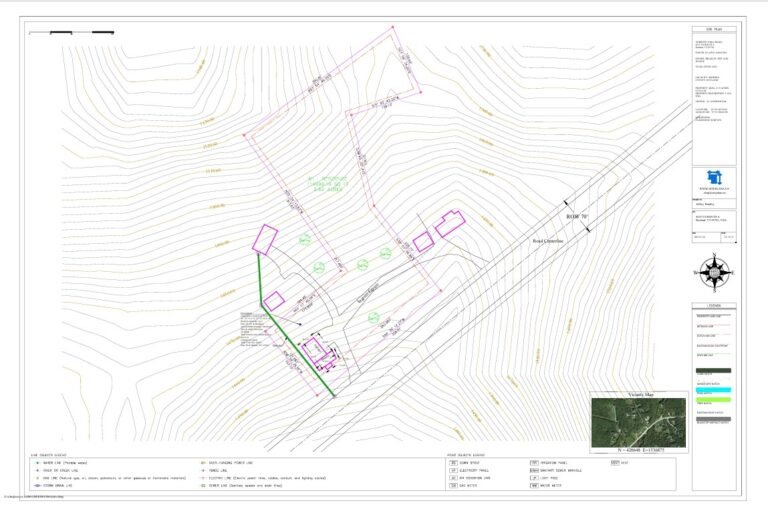
Your building department asked for a site plan. You searched for one. Now you're looking at two different things — certified plans that cost $400 and take two weeks, and non-certified plans that cost $89 and arrive tomorrow — and you're not sure which one your permit actually needs.
Most residential homeowners need the second one.
Here’s how to know for certain — and why getting this wrong in either direction costs you time or money you didn’t need to spend.
What "Certified" Actually Means
A certified site plan is a document prepared and stamped by a licensed professional — either a licensed land surveyor or a licensed engineer — who carries legal liability for its accuracy.
The stamp means the professional is certifying that the boundary locations, dimensions, and elevations shown on the plan are accurate to a surveying standard. That certification has legal weight. It can be used in property disputes, title transfers, mortgage transactions, and legal proceedings. It requires a site visit, physical measurement of the property, and professional licensure in the state where the property is located.
Certified plans cost more because they require more — licensed professionals, field work, liability insurance, and state-regulated standards for accuracy and recordkeeping.
When a certified plan is required:
- Boundary disputes requiring legally defensible documentation
- Mortgage transactions where the lender requires a survey
- Title insurance when the title company requires a survey endorsement
- New construction on lots with ambiguous or disputed boundaries
- Commercial development requiring ALTA/NSPS surveys
- Some high-value additions where the municipality requires a licensed surveyor stamp
What "Non-Certified" Means — And Why It Passes Most Residential Permits
A non-certified site plan is a professionally drafted document prepared from county parcel records, recorded plat data, and GIS information. It shows the same information a permit reviewer needs — property lines, setbacks, existing and proposed structures, lot coverage, flood zone, and city-specific notes — without a licensed surveyor’s stamp.
It is not a legal boundary document. It cannot be used to resolve a boundary dispute or satisfy a mortgage survey requirement.
What it can do — and what it’s specifically designed to do — is satisfy the site plan requirement on a residential building permit application.
The vast majority of US building departments accept non-certified, professionally drafted site plans for standard residential projects. The permit reviewer is not evaluating the legal accuracy of your boundary locations. They’re checking whether your proposed structure clears the required setbacks, whether your lot coverage stays within the district maximum, and whether the city-specific notes required for your parcel appear on the plan.
None of that requires a licensed surveyor’s stamp. It requires a plan that’s accurate, complete, and formatted to the city’s submittal requirements.
That’s what we provide.
What Your Building Department's Checklist Actually Says
Most residential permit applications list the site plan requirement something like this:
“Site plan or plot plan showing property boundaries, existing structures, proposed construction, and setback dimensions from all property lines.”
Notice what it doesn’t say: licensed surveyor, certified, stamped, or sealed.
Some jurisdictions add language like “drawn to scale” or “prepared by a qualified professional” — language that describes the quality of the document without requiring a licensed stamp.
The jurisdictions that do require a certified or stamped plan for residential permits are the minority — and they’re usually explicit about it. If your permit checklist says “survey required” or “licensed surveyor stamp required,” that’s a certified plan requirement. If it says “site plan” or “plot plan” without specifying licensure, a professionally drafted non-certified plan almost always satisfies it.
If you’re unsure what your jurisdiction requires, we’ll verify it for your specific city before you order. If your project requires a certified plan, we’ll tell you before you pay — not after.
Side-by-Side Comparison
| Certified Site Plan | Non-Certified Site Plan | |
|---|---|---|
| Prepared by | Licensed land surveyor or engineer | Professional drafter using parcel records and GIS data |
| Requires site visit | Yes — physical measurement of property | No — prepared remotely from county records |
| Legal standing | Legally defensible boundary document | Permit document — not for legal boundary disputes |
| Turnaround | 1–3 weeks typically | 24 hours |
| Cost | $300–$1,500+ depending on lot complexity | $89–$249 fixed price |
| Required for mortgage/title | Often yes | No |
| Accepted for residential building permits | Yes | Yes — in the vast majority of US jurisdictions |
| Required for residential building permits | Rarely — only when checklist explicitly states it | Most standard residential projects |
| Flood elevation certificate | Separate document — prepared by licensed surveyor | Not applicable |
| Boundary disputes | Appropriate | Not appropriate |
The Projects Where This Question Comes Up Most
ADU permits: Homeowners searching for ADU site plans frequently encounter the certified vs. non-certified question. In most US cities — including Sacramento, Jacksonville, Raleigh, Austin, and Dallas — a non-certified professionally drafted plan satisfies the ADU permit site plan requirement. The ADU ordinance may require other documents (floor plans, structural drawings, energy compliance) that need professional stamps, but the site plan itself typically does not.
Home additions: Same pattern. The structural drawings for an addition require an architect or engineer. The site plan showing where the addition sits on the lot does not.
Garage and accessory structure permits: Almost universally accepted as non-certified. Building departments reviewing a detached garage permit are checking setbacks and lot coverage — not legal boundary accuracy.
Pool permits: Non-certified plans accepted in the vast majority of jurisdictions. Some counties require a survey for pool permits near property boundaries to verify encroachment — but that’s the exception, not the rule.
Fence permits: Non-certified plans accepted for virtually all residential fence permits. The property line location shown on the plan comes from recorded plat data — which is the same source the reviewer references.
When You Actually Need a Certified Plan — Be Honest With Yourself
There are situations where a non-certified plan is the wrong tool regardless of what the permit checklist says:
Your lot has a boundary dispute. If you and your neighbor disagree about where the property line is, a site plan drawn from recorded plat data won’t resolve it. You need a licensed surveyor to establish the legal boundary. Build the fence, the addition, or the ADU after the boundary is settled — not before.
Your parcel was subdivided recently or has an unusual history. Recent lot splits, boundary adjustments, or parcels carved from larger tracts sometimes have recorded plat data that doesn’t reflect the physical reality on the ground. A non-certified plan will reflect the recorded data. If the recorded data is wrong, the plan will be wrong too — and the error may not surface until construction begins.
Your lender or title company requires a survey. If you’re financing a construction project and the lender requires a boundary survey as a condition of the loan, a non-certified site plan won’t satisfy that requirement. You need a licensed surveyor.
The permit checklist explicitly says “survey required” or “licensed stamp required.” If the checklist is clear, follow it. We’ll verify this for your jurisdiction before you order.
In all other standard residential permit situations — which covers the overwhelming majority of homeowners building garages, ADUs, additions, pools, decks, sheds, and fences — a professionally drafted non-certified site plan is the right document.
What We Provide — And What It's Designed to Do
Every plan we produce is professionally drafted from county recorder parcel data, recorded plat dimensions, and city GIS information. It reflects what the reviewer will compare against — not GIS approximations, not aerial guesses, but the legal dimensions from the recorded plat.
It includes every element on your city’s submittal checklist: property lines, setbacks to the correct measurement point, lot coverage calculation with line items, flood zone notation where required, tree protection notes where required, easement references from county recorder records, and city-specific notes your reviewer needs to see on the plan face.
It is not a certified survey. It is a permit document — built to satisfy the permit requirement, formatted to your city’s submittal standards, and delivered in 24 hours at a fixed price.
For the vast majority of residential permits, that’s exactly what you need.
$89 for standard residential projects. $259 for ADUs and complex lots. Free revisions if the city returns correction comments.
Order Your Site Plan – $89 →
FAQs
“Site plan required” without additional language specifying a licensed stamp or surveyor means a non-certified professionally drafted plan will satisfy the requirement in the vast majority of US jurisdictions. If the checklist says “survey required,” “licensed surveyor required,” or “certified plan required,” that’s a different standard. We verify the requirement for your specific city and permit type before drafting begins.
A survey is a legally certified boundary document prepared by a licensed land surveyor. It establishes boundary locations with legal authority and can be used in title transactions, mortgage requirements, and boundary disputes. A site plan is a permit document showing proposed improvements relative to the property and demonstrating zoning compliance. Most residential permits require the latter. If you need a certified survey, we can refer you to licensed surveyors in your area.
In most US cities, yes. Sacramento, Jacksonville, Raleigh, Austin, Dallas, Phoenix, Atlanta, Charlotte, Nashville, Denver, Portland, Seattle — all accept professionally drafted non-certified plans for ADU permit applications. The ADU permit may require other stamped documents — structural drawings, energy calculations — but the site plan component is typically non-certified. We verify for your specific jurisdiction before drafting.
It’s rare for a building department to reject a non-certified plan on residential projects when the checklist doesn’t specify certification — but if it happens, we’ll tell you before any money changes hands. We verify the requirement for your city before accepting the order. If certification is genuinely required, we won’t take your order for a non-certified plan.
Your existing survey is useful — the boundary dimensions help us draft an accurate plan. But a survey and a site plan are different documents. The survey establishes legal boundaries. The site plan shows proposed construction and zoning compliance. Your permit application needs the latter. If you have a survey, share it with us at checkout — it makes our research faster and the plan more precise.
We pull parcel dimensions from county recorder records — the recorded plat that established your lot’s legal boundaries when the subdivision was created. That’s the same source the permit reviewer references when they compare your plan against official records. For most residential lots, recorded plat dimensions are accurate and sufficient for permit purposes. Where recorded data is ambiguous or a recent boundary change has occurred, we’ll flag it before the plan is finalized.
If Your Project Needs a Site Plan — Not a Survey — We've Got It
Pool Site Plan for Permits We've Worked Across These Cities
ADU rules are local. Every order includes jurisdiction-specific research — not a static template