
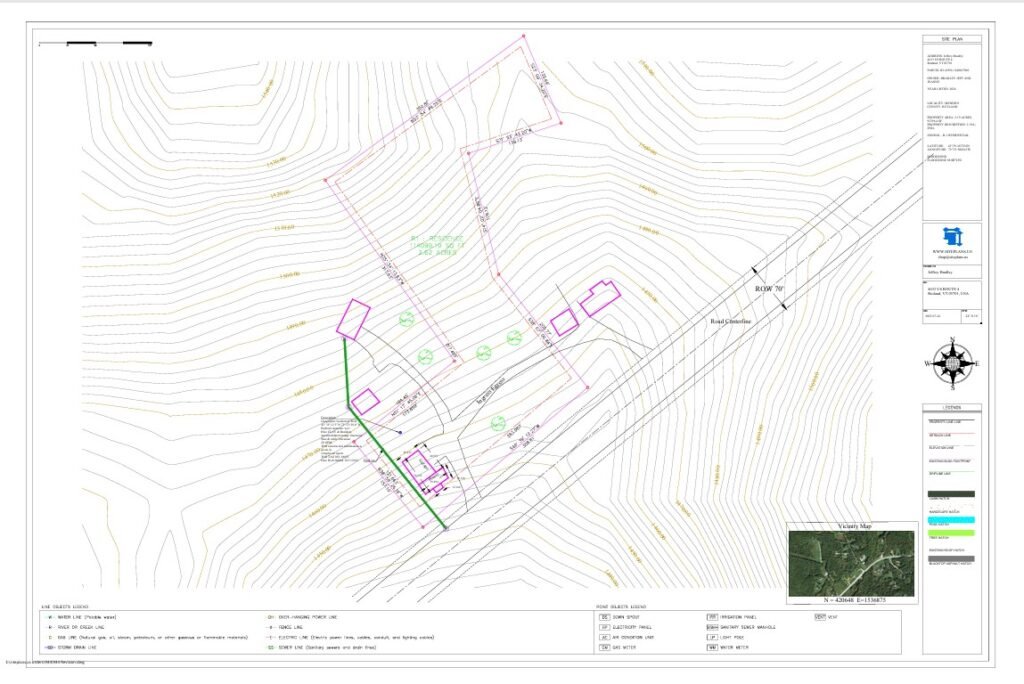
A 12x16 shed. Prefab from the home improvement store. Delivered on a flatbed, set in the backyard, done in a day.
Then the neighbor files a complaint. Or you go to sell the house and the inspector flags an unpermitted structure. Or you try to pull the permit before construction and find out the building department wants a site plan showing the shed’s location relative to property lines, setbacks, easements, and existing structures — with a lot coverage calculation that includes your driveway, patio, and the deck you added four years ago.
For a shed.
Here’s the thing: the permit process for a shed is genuinely simple. The site plan requirement isn’t punitive — it’s a one-page document showing the reviewer that your 192-square-foot structure clears the rear and side setbacks, doesn’t sit on a utility easement, and doesn’t push your lot over its coverage maximum.
That document takes us 24 hours to produce. It takes most homeowners two weeks of confusion, two phone calls to the building department, and one rejected DIY attempt to not produce.
$89. Tomorrow. Free revisions if it comes back.
Why Shed Permits Trip People Up More Than They Should
Sheds are the most underestimated permit project in residential construction. Homeowners assume that because the structure is small, the permit process is proportionally simple. It mostly is — but “mostly” is doing a lot of work in that sentence.
The site plan requirement for a shed is the same fundamental document as for a garage or an addition. Property lines from recorded plat dimensions. All setback distances from property lines to the shed’s furthest projection — which on a prefab shed with roof overhangs means measuring to the eave, not to the wall. A lot coverage calculation that includes every impervious surface on the parcel, not just the shed itself.
And the part that catches homeowners who’ve been on the lot for fifteen years: the easement they forgot about.
Most residential lots in subdivisions developed after 1960 have a utility easement running along the rear property line — typically 10 feet wide. That’s exactly where most people want to put a shed. A shed foundation poured inside that easement produces a comment that can’t be resolved with a revised plan. It requires either moving the structure or obtaining a utility company sign-off that can take months.
We locate easements from county recorder records before the shed footprint goes on the plan. Because the time to find out about the easement is before the concrete is poured, not after.
What Shed Permit Correction Letters Actually Say
“Setback dimensions shown to wall face. Measurement required to furthest projection including roof overhang. Resubmit with corrected dimensions.”
Prefab sheds have eave overhangs — sometimes 12 to 18 inches on each side. That overhang counts toward the setback. A shed that clears the 5-foot side setback at the wall may not clear it at the eave. We measure to the furthest projection every time.
“Proposed shed location conflicts with 10-foot utility easement along rear property line. Permanent structures prohibited within easement boundaries. Resubmit with revised footprint location or provide utility company authorization.”
This is the comment that turns a simple shed permit into a multi-month project. We identify easements from county recorder records before the footprint is placed — not after the reviewer finds it.
“Lot coverage calculation not provided. Existing driveway, patio, and accessory structures not included. Maximum lot coverage for this district is 40%. Complete impervious surface tally required.”
A 192-square-foot shed on a lot that’s already at 38% coverage in a 40% district doesn’t get approved without the math showing it. We calculate everything — house, driveway, existing deck, existing shed if there is one, and the new structure.
“Shed location not dimensioned from all property lines. Setback distances required from rear and both side property lines. Resubmit with complete dimensions.”
We label setback distances from every property line on the plan — not just the ones that seem relevant. Reviewers need the complete picture.
“Property lines shown from GIS data. Dimensions do not match recorded plat. Resubmit using legal plat dimensions.”
GIS coordinates are rounded approximations. Reviewers compare submitted plans against the recorded plat. We pull dimensions from the county recorder record — the same source the reviewer uses.
What Your Shed Site Plan Includes
Simple project. Complete documentation. Here’s what goes on every shed plan we deliver:
| Element | Why It’s There |
|---|---|
| Property lines from recorded plat | Legal dimensions — not GIS data. Matches what the reviewer compares against. |
| Existing primary structure footprint | Required for lot coverage calculation and spatial reference |
| Proposed shed footprint with dimensions | All four sides dimensioned; eave overhang noted |
| Setbacks from all property lines | Rear, side-left, side-right — measured to the eave, not the wall |
| Utility easements with instrument references | Located from county recorder records; easement width and clearance shown |
| Lot coverage calculation | House + shed + driveway + patio + deck + all existing hardscape = total % of lot |
| Existing accessory structures | Any existing shed, garage, or outbuilding shown — affects coverage math |
| North arrow, engineering scale, legal description | Required on every permit submittal without exception |
| Flood zone notation | Added for parcels in or near flood-mapped areas |
| City-specific notes | Tree ordinance, impervious limits, or other local requirements per jurisdiction |
The Setback Rules for Sheds Vary More Than You'd Think
Accessory structure setbacks — the rules that apply to sheds, detached garages, and similar structures — are almost always different from the setback rules that apply to the primary house. In most residential zoning districts, accessory structures are allowed closer to property lines than the house is. But “closer” still means a specific number, and that number varies significantly by city and zoning district.
Common accessory structure setback ranges across US jurisdictions:
- Rear yard: 3 to 10 feet (most common: 5 feet)
- Side yard: 3 to 7.5 feet (most common: 5 feet)
- From primary structure: 6 to 10 feet (some cities require fire separation distance)
- From utility easement: must clear easement boundaries entirely
Some cities have a size threshold below which a shed doesn’t require a permit at all — structures under 120 square feet or under 200 square feet in some jurisdictions are exempt. We verify whether your shed triggers the permit requirement before you order. If it doesn’t, we’ll tell you upfront.
Some cities also restrict the total number of accessory structures on a residential lot, or cap the combined square footage of all accessory structures as a percentage of the primary structure’s floor area. If your property already has a shed or detached garage, a second shed may trigger a review of the total accessory coverage. We check this before drafting.
Shed Permits Across the Cities We Know
Sacramento, CA — Accessory structures: 5-foot rear and side setbacks in most residential districts. Tree ordinance applies if disturbance area touches a protected species’ drip line. Lot coverage calculation includes all impervious surfaces. Eave measurement required.
Jacksonville, FL — Accessory structure setbacks: 5 feet rear and side in RLD-60. Grand tree (24″+ DBH) must appear on plan if within disturbance area. Lot coverage tracked against district maximum. Flood zone notation for AE zone parcels.
Raleigh, NC — Accessory structure setbacks vary by zoning district. Impervious surface listed as line items — shed square footage noted separately. Pre-May 2001 lots under grandfathered stormwater framework.
Austin, TX — Impervious cover limit by watershed zone applies to shed footprint and any associated hardscape. Heritage tree root zone check if within 50 feet of a 19″+ DBH tree.
Dallas, TX — Lot coverage and impervious tracked separately. Easement references from Dallas County deed records. Setbacks per zoning district.
Phoenix, AZ — Accessory structure setbacks: typically 3 feet side and rear in R1-6 and R1-8 districts. Permit required for structures over 200 square feet. Lot coverage tracked.
Clarksville TN — Clarksville’s growth — driven partly by Fort Campbell’s presence and partly by Nashville-corridor spillover — means Montgomery County’s Building and Codes office processes a high volume of accessory structure permits. The site plan is what moves a shed application through cleanly. From Basic $89.
Do You Actually Need a Permit for Your Shed?
Probably — but the threshold varies by city. Here’s how to think about it:
Most US jurisdictions require a permit for sheds over 120–200 square feet. The exact threshold varies. Some cities require permits for any permanent structure regardless of size. Others exempt small sheds under a specific square footage.
“Permanent” is the operative word. A shed on a concrete foundation or with anchoring to the ground is typically considered permanent regardless of size. A small prefab shed sitting on gravel or pavers with no anchoring may be exempt in some cities.
HOA rules are separate from city permit requirements. Your city might not require a permit for a 150-square-foot shed, but your HOA might require design approval regardless. Those are two different processes.
The cost of building without a permit. An unpermitted shed can complicate a home sale — title companies and buyers’ inspectors flag unpermitted structures. Retroactive permits are possible in most cities but typically require a site plan, an inspection of the as-built structure, and sometimes demolition and reconstruction to meet current standards. Building with a permit the first time is cheaper than retroactive compliance.
If you’re not sure whether your shed requires a permit, enter your address at checkout and describe the project. We’ll verify the requirement for your jurisdiction before drafting begins.
Pricing
| Plan | Price | Best For |
|---|---|---|
| Basic – $89 | Standard shed permit on a straightforward residential lot | Property lines, shed footprint, setbacks to eave, easements, lot coverage, north arrow, scale |
| Enhanced – $159 | Shed near flood zone, protected trees, or with utility complexity | Adds FEMA data, tree notation, utility connection reference, impervious line items |
✅ Free revisions on any correction comments
✅ 24-hour turnaround
✅ All 50 states
✅ No survey required
Order Your Shed Site Plan – Starting Tier $89 →
FAQs — Shed Permit Site Plans
It depends on your city’s permit threshold — some jurisdictions exempt structures under 120 square feet, others require permits for any permanent structure regardless of size. We verify the threshold for your jurisdiction before drafting. If your shed falls below the permit requirement, we’ll tell you and you won’t be charged.
Yes. A retroactive permit — sometimes called an “after-the-fact” permit — typically requires the same site plan as a permit pulled before construction. We draft the plan showing the shed’s current location. The building department then inspects the as-built structure to verify it meets current setback and code requirements. If it doesn’t, you may need to relocate it. We can’t change that outcome, but the plan we provide gives you the clearest path to resolution.
Not necessarily. Fences are frequently built inches or even feet inside the actual property line — sometimes intentionally, sometimes not. A shed positioned against a fence can easily encroach on the required setback or even cross the property line itself. We use recorded plat dimensions for boundary locations, not the fence line.
Yes, and it matters more on prefab sheds than on custom-built ones because the overhangs are standardized and often larger than homeowners expect — typically 12 to 18 inches per side on many prefab models. A shed with a 16-inch eave overhang positioned 5 feet from the property line at the wall is actually 3 feet 8 inches from the property line at the eave. In a district with a 5-foot accessory structure setback, that fails. We measure to the eave.
Most utility easements prohibit permanent structures — including sheds — within their boundaries. The typical rear utility easement runs 10 feet from the rear property line. If your planned shed location falls within that easement, the building department will return the permit application asking you to move the structure. We find easements before we place the shed footprint so you know the constraint before you pour a foundation.
Possibly, depending on your city’s rules on total accessory structure coverage. Some jurisdictions limit the combined footprint of all accessory structures to a percentage of the primary structure’s floor area. Others cap the total number of accessory structures on a residential lot. We check both constraints before drafting so you know whether a second shed is a straightforward permit or a more complex approval.
Order Your Shed Site Plan – Basic $89 →
Other Project Site plan Types We Cover
Pool Site Plan for Permits We've Worked Across These Cities
ADU rules are local. Every order includes jurisdiction-specific research — not a static template