
Half the permit guides you'll find online still say "DCRA." That agency hasn't issued building permits since October 2022. If the service drafting your site plan is still using outdated DC permit terminology, the plan they produce probably reflects outdated DC permit standards too.
Washington DC’s Department of Buildings — DOB, not DCRA — overhauled its entire electronic plan submission platform in February 2025. As of October 2025, every permit applicant, residential or commercial, must complete DOB’s online pre-submission checklist before filing in ProjectDox. The review system routes applications through multiple concurrent disciplines — Zoning, Structural, Mechanical, and potentially the DC Historic Preservation Office — each of which can independently place a hold on the application.
One hold from any discipline means nothing moves forward.
DC residential permits also carry complications that don’t exist in most other US cities: historic district coverage that touches entire neighborhoods, a building plat requirement separate from the site plan, an alley network that creates rear-loading ADU configurations unique to DC’s row home fabric, and lot occupancy limits calculated differently than standard lot coverage in other jurisdictions.
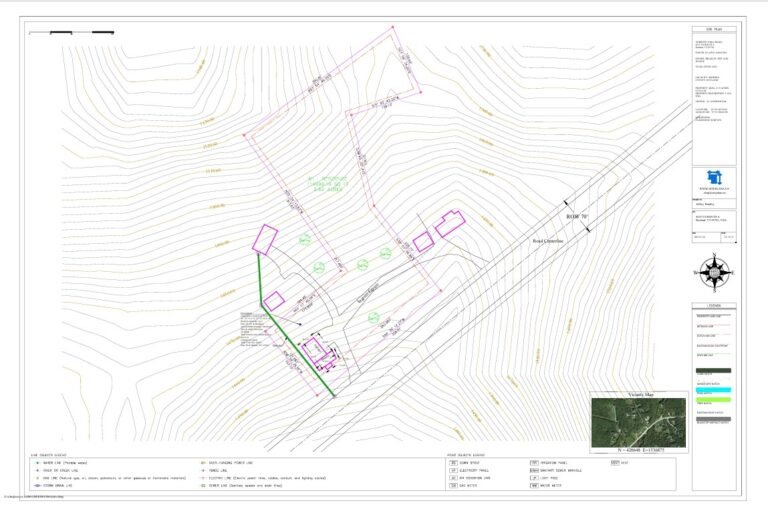
We draft DC site plans to DOB’s current submittal standards — not a template last updated when DCRA still issued permits.
$89 for standard residential projects. $249 for ADUs and complex parcels. Delivered in 24 hours. Free revisions if DOB sends correction comments.
What Makes Washington DC Permits Different From Every Other City
DC is not a standard US permit market. Several features of its regulatory environment create complications that catch homeowners — and out-of-town services — off guard.
DOB replaced DCRA in 2022 — and updated ProjectDox in 2025. Building permits, inspections, and plan reviews now fall under the Department of Buildings (DOB). Any guide still referring to “DCRA permits” for construction approvals is out of date. On February 18, 2025, DOB launched a significant overhaul of ProjectDox, its electronic plan submission and review platform, introducing a more stable cloud-based architecture and a new Excel-based comment response system. A plan submitted through the old workflow or formatted to the old standards creates friction at intake before review even begins.
Pre-submission checklist required since October 2025. Effective October 20, 2025, all applicants — residential and commercial — must first complete DOB’s online pre-submission checklist before filing a permit application in ProjectDox. Skipping this step delays the application before a single reviewer sees it.
Concurrent multi-discipline review — any hold stops everything. Each discipline will review and approve the plans, or put a hold on the application if DOB’s plan review comments note that corrections are needed. Final building permit approval is not given until all disciplines and external agencies have approved and stamped the plans. For residential projects, that typically means Zoning and Structural at minimum — and Historic Preservation for any property in a designated district.
Historic district coverage is pervasive. DC’s historic districts aren’t isolated pockets — they cover Capitol Hill, Georgetown, Dupont Circle, Logan Circle, Shaw, LeDroit Park, Takoma, and dozens of other neighborhoods. A Certificate of Appropriateness (COA) issued by the DC Historic Preservation Office (HPO) is required if the property is in a designated historic district or listed on the DC Inventory of Historic Sites and the proposed work is subject to HPO jurisdiction. A plan submitted without acknowledging the HPO requirement gets returned before Zoning review begins.
Building plat vs. site plan — DC requires both. DC uses a specific document called a building plat — prepared by the DC Office of the Surveyor — that documents the building footprint, setbacks, and lot occupancy for assessment purposes. The building plat documents the building footprint for assessment and provides the dimensions for the building area, front, rear, and side yard setbacks, court areas and penthouse setbacks. The site plan we provide is the permit document showing proposed construction and zoning compliance. The building plat is a separate official document. We’ll clarify which your specific project requires and whether both are needed before drafting begins.
Lot occupancy, not lot coverage. DC calculates development intensity through “lot occupancy” — the percentage of the lot area covered by structures — which functions similarly to lot coverage in other cities but is calculated and expressed differently under 11 DCMR. Plans that show “lot coverage” using another city’s methodology rather than DC’s lot occupancy framework produce Zoning division comments.
Alley network shapes ADU placement. DC’s historic alley system — the network of service alleys running behind row homes in Capitol Hill, Columbia Heights, Shaw, and other neighborhoods — creates rear-loading ADU opportunities that are unique to DC’s urban fabric. Many DC properties have alley access enabling rear-loading ADU placement. Detached ADUs must be located a minimum of 7.5 feet from the centerline of the alley if applicable. Plans that don’t account for the alley centerline setback produce a Zoning hold on the first submission.
What DC Permit Correction Comments Look Like
“Site plan does not reflect current DOB submittal format. Pre-submission checklist not completed prior to filing. Application returned for completion of pre-submission requirements before resubmission.”
The pre-submission checklist is a hard gate since October 2025. We flag this requirement for every DC order so your application isn’t returned at intake.
“Lot occupancy calculation not provided. Proposed addition increases lot occupancy. Maximum lot occupancy for R-1-B zone must be verified and shown on plan. Zoning hold placed.”
DC’s lot occupancy framework under 11 DCMR is different from the lot coverage calculations used in other cities. We calculate and express it correctly for the applicable DC zone district.
“Property located within Capitol Hill Historic District. Certificate of Appropriateness from DC Historic Preservation Office required prior to permit issuance. HPO hold placed on application.”
Historic district coverage in DC is extensive. We identify HPO requirements at the parcel level before the plan is drafted — not after the hold appears.
“ADU setback from alley centerline not shown. Detached accessory structure must maintain 7.5-foot clearance from alley centerline per 11 DCMR. Resubmit with alley centerline location and setback dimension shown.”
Alley centerline setbacks are DC-specific. We locate the alley from District records and show the 7.5-foot clearance on every plan where alley access is present.
“Building Height Measuring Point (BHMP) not identified on plan. BHMP required for height compliance verification per DC Zoning Regulations. Zoning hold placed.”
DC uses a specific Building Height Measuring Point methodology for height compliance — different from the grade-based measurement most other cities use. We identify the BHMP on every plan involving vertical construction.
“Rear yard setback for accessory dwelling unit not compliant. Detached ADU requires 12-foot rear yard setback per 11 DCMR 1000 series. Plan shows 8-foot setback. Resubmit with revised footprint.”
DC’s ADU rear yard setback of 12 feet is more restrictive than most US cities. We verify it against the 11 DCMR 1000 series standard before placing the ADU footprint.
DC-Specific Elements on Every Site Plan We Deliver
| Element | Why DC Reviewers Require It |
|---|---|
| Lot occupancy calculation per 11 DCMR | DC’s framework — not generic lot coverage — expressed as % of lot area under structures |
| Zone district identification from DC Zoning Map | R-1-A through RF zones each carry different standards; verified from dcoz.dc.gov |
| Setbacks per applicable zone district | Front 12–20 ft typical; side and rear vary by zone; ADU setbacks per 11 DCMR 1000 series |
| ADU rear yard setback — 12 feet minimum | More restrictive than most US cities; verified before footprint is placed |
| Alley centerline location and 7.5-foot clearance | Required for any rear-loading ADU or accessory structure with alley adjacency |
| Building Height Measuring Point (BHMP) | DC-specific height compliance methodology — identified on all plans with vertical construction |
| Historic district notation and HPO requirement | Flagged for properties in any DC historic district or on DC Inventory of Historic Sites |
| Property lines from DC Office of the Surveyor records | Legal plat dimensions — not GIS data |
| North arrow, engineering scale, legal description, Square/Lot number | DC uses Square/Lot notation; missing it causes intake rejection |
| Utility connection points | DC Water connections shown; easements referenced from District records |
DC ADU Rules — What the Site Plan Must Reflect
DC’s accessory dwelling unit framework under 11 DCMR 1000 series has several features that differ from the rest of the country:
Size: Detached ADU up to 1,000 sq ft with a maximum height of 20 feet. Attached ADU up to 35% of primary dwelling gross floor area.
Setbacks: Rear setback minimum 12 feet for detached ADUs. Side yard setback 3 feet. DC’s row home neighborhoods — common in Capitol Hill, Columbia Heights, Shaw — have zero side setbacks for primary dwellings; ADUs sited in rear yards.
Alley clearance: The ADU may be built within a rear yard but must be located a minimum of 7.5 feet from the centerline of the alley, if applicable.
Parking: No minimum parking required for ADUs in Washington DC. 11 DCMR explicitly waives parking for ADUs.
One per lot: One ADU per lot in R-1-A through R-3 zones.
Historic overlay: If the property is in a historic district, the ADU design must receive a Certificate of Appropriateness from HPO before DOB will issue the permit. This is separate from the building permit process and can add 2–4 months.
A site plan that doesn’t reflect all of these standards — particularly the 12-foot rear setback, the alley centerline clearance, and the historic overlay requirement — will come back from Zoning before structural review begins.
Historic Districts in DC — What's Covered and What It Means
DC’s historic preservation program is administered by the DC Historic Preservation Office under the State Historic Preservation Officer. It covers:
Local historic districts — Capitol Hill, Georgetown, Dupont Circle, Kalorama Triangle, Logan Circle, Mount Pleasant, LeDroit Park, Shaw, Blagden Alley/Naylor Court, Takoma, and many others. Properties in these districts require a COA for exterior work.
DC Inventory of Historic Sites — Individual landmarks listed separately from district designation. A property on the Inventory that isn’t in a local historic district may still require HPO review for exterior alterations.
National Register properties — Federal designation; HPO review required for federally funded or federally permitted projects but not typically for private residential permits. However, properties in National Register districts that are also local historic districts require the full COA process.
For a homeowner in Capitol Hill planning a rear addition, the process is: verify HPO jurisdiction → apply for COA → receive COA → file building permit application with COA attached → DOB review begins.
We identify HPO jurisdiction at the parcel level before the plan is drafted. We note the COA requirement on the plan. The COA application itself is a separate process with HPO — we can’t file it for you, but knowing about it before you submit to DOB saves you the hold.
DC Permit Timelines — What to Expect
Simple residential projects take 2–4 months in DC. Complex residential renovations need 4–6 months. Historic district properties add another 2–4 months minimum.
That’s the full permit-to-groundbreaking timeline. The site plan is the document that starts the clock — and a site plan with correction comments adds a resubmission cycle of 10–15 business days to that timeline.
The first review cycle takes 15–30 business days. Reviewers provide comments and required corrections. Resubmissions review in 10–15 days each.
A complete first submission — one that closes every Zoning hold before it’s placed — doesn’t eliminate DC’s review timeline, but it doesn’t add to it either. That’s the difference a site plan built for DOB’s actual checklist makes.
Pricing
| Plan | Price | Best For |
|---|---|---|
| Basic – $89 | Standard residential permit in non-historic DC zone | Property lines, structures, setbacks, lot occupancy, BHMP notation, Square/Lot number, north arrow, scale |
| Enhanced – $159 | Properties near alleys, with tree coverage, or utility complexity | Adds alley centerline clearance, tree notation, easement references, utility connections |
| Premium – $249+ | ADUs, additions, historic district properties, complex lots | Full 11 DCMR ADU compliance, historic overlay identification, HPO requirement notation, BHMP calculation, lot occupancy per DC framework |
✅ Free revisions on any DOB correction comments ✅ 24-hour turnaround on most residential projects ✅ ProjectDox-formatted PDF delivery ✅ Pre-submission checklist guidance included
FAQs — Washington DC Site Plans
No. DCRA was split into two agencies in October 2022. Building permits, plan reviews, and inspections now fall under the DC Department of Buildings (DOB). Business licenses are handled by the Department of Licensing and Consumer Protection (DLCP). Any service or guide still referencing DCRA for permit approvals is working from outdated information.
ProjectDox is DOB’s electronic plan submission and review platform. All residential and commercial permit applications in DC are submitted through ProjectDox. DOB overhauled the platform in February 2025 with a new interface, cloud-based architecture, and Excel-based comment response system. Since October 2025, all applicants must complete DOB’s online pre-submission checklist before filing in ProjectDox. We deliver plans in PDF format compatible with ProjectDox upload requirements.
Yes, significantly. Capitol Hill is a local historic district. Any exterior work — additions, new accessory structures, ADUs, even fence and deck modifications — requires a Certificate of Appropriateness from the DC Historic Preservation Office before DOB will issue the building permit. The COA process runs parallel to but separately from the permit process. We identify the HPO requirement on your plan and flag it before you submit to DOB.
Functionally similar but calculated and expressed differently. DC uses “lot occupancy” under 11 DCMR — the percentage of the lot area covered by structures. Most other US cities use “lot coverage” or “impervious surface” as broader categories that include hardscape like driveways and patios. DC’s lot occupancy calculation focuses specifically on structural footprints. We calculate it correctly under DC’s framework, not a generic residential standard
DC identifies parcels using a Square/Lot notation from the DC Office of the Surveyor — for example, “Square 1045, Lot 0012.” This is DC’s parcel identification system, separate from the street address. DOB requires the Square/Lot number on permit applications and plan submissions. Plans submitted without the correct Square/Lot notation create intake delays. We pull the correct Square/Lot from the DC Office of the Surveyor records for every order.
For simple residential projects — a garage, shed, or deck in a non-historic zone — expect 2–4 months from complete application to permit issuance. For ADUs or additions, 4–6 months. For anything in a historic district, add 2–4 months for the HPO COA process. A complete first submission with no correction comments doesn’t shorten DC’s review timeline significantly — but it doesn’t add 10–15 business day resubmission cycles to it either.
Other Cities We Deliver for US Homeowners
ADU Site Plans | Garage Site Plans | Home Addition Site Plans | Deck Site Plans | Shed Site Plans | Fence Site Plans
City pages with documented local pool permit requirements:
Sacramento | Jacksonville | Raleigh | Austin | Dallas | Fort Worth
Pool Site Plan for Permits We've Worked Across These Cities
Based on DC Department of Buildings (DOB) submittal requirements, 11 DCMR zoning regulations, and DC Historic Preservation Office procedures as of June 2026. DOB overhauled ProjectDox in February 2025; pre-submission checklist mandatory since October 2025.
DC Permit Official Resources
- DC Department of Buildings (DOB) — 1100 4th Street SW, Washington, DC 20024. Main line: (202) 442-4400
- ProjectDox permit portal — All residential permit submissions: permit.dcra.dc.gov
- DOB Permit Wizard — Identify required permits and plan review disciplines before applying: dob.dc.gov
- DC Office of Zoning (DCOZ) — Zoning map, 11 DCMR text, zoning interpretations: dcoz.dc.gov
- DC Historic Preservation Office (HPO) — Historic district maps, COA applications: historicpreservation.dc.gov
- DC Office of the Surveyor — Building plats, Square/Lot records, recorded plat dimensions: surveyor.dc.gov
- DC Zoning Regulations (11 DCMR) — Full text including ADU standards (1000 series): dcregs.dc.gov