
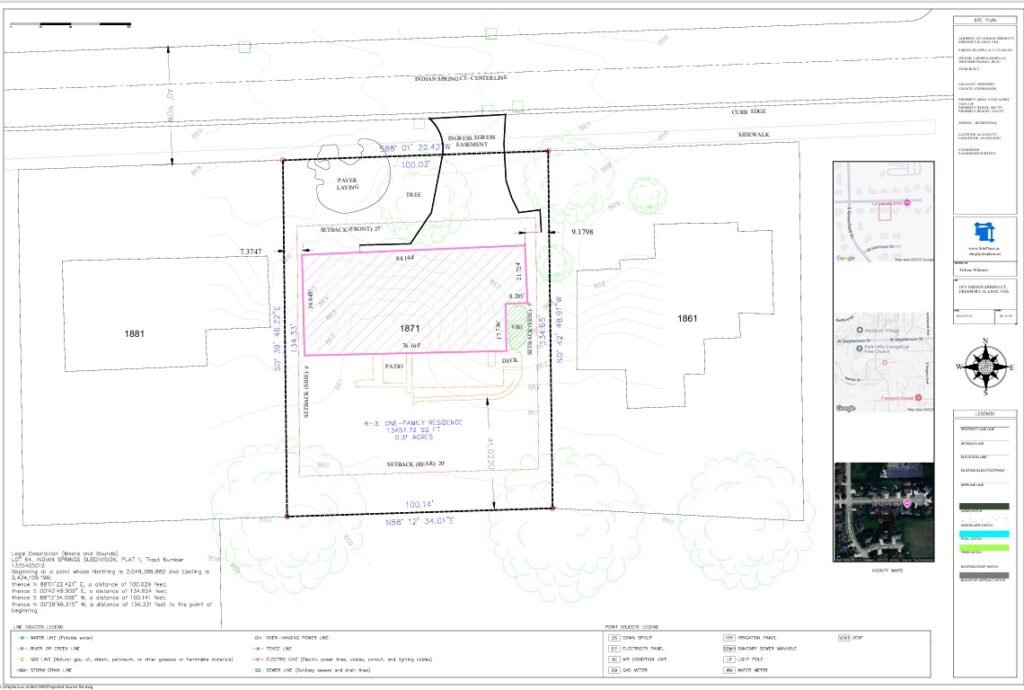
The permit counter doesn't care how long you've owned the property. It cares whether the plan in front of the reviewer shows the right setbacks, the right lot coverage, and the right city-specific notes. Ours do.
Residential permits get held up for one of three reasons: the plan is missing something required, it’s measuring something incorrectly, or it doesn’t reflect the specific standards of that city’s zoning code.
None of those are structural problems with your project. They’re paperwork problems — and paperwork problems have a 24-hour fix.
Enter your address. Select your project. We research your parcel, verify your zoning district, draft to your city’s submittal format, and deliver a PDF you can upload to the permit portal tomorrow morning.
$89. No hourly billing. No site visit. Free revisions if corrections come back.
Every Residential Permit Starts With the Same Document
Doesn’t matter if you’re adding a bedroom, building a detached garage, putting in a pool, or converting the backyard into an ADU. Before structural review begins, before the inspector is scheduled, before the contractor breaks ground — the building department needs a site plan.
That plan answers four questions every reviewer is trained to check:
Where are the property boundaries? Legal plat dimensions, not GIS approximations. Reviewers in most jurisdictions compare submitted plans against the recorded plat. Rounded coordinates fail that comparison.
Where does the proposed structure sit relative to those boundaries? Setback dimensions measured to the correct building element — eave, overhang, or wall face depending on the jurisdiction. Not the foundation. Not an estimated line. The actual furthest projection.
How much of the lot is being covered? Existing hardscape plus proposed construction, expressed as a percentage of lot area. Most residential zoning districts have a maximum. Plans that don’t show the math get a comment that sends them back to the queue.
What city-specific requirements apply? Flood zone designation. Tree protection ordinance. Riparian buffer. ADU size cap. Historic overlay. These vary by city and by parcel — and they’re what separates a plan that clears review from one that comes back with three comments.
What Residential Site Plans Get Flagged For Most Often
These aren’t edge cases. These are the correction comments that appear on residential permit applications week after week across US building departments:
Setback measured to foundation — Every jurisdiction measures to the furthest projection of the structure. Eave, gutter, overhang, cantilevered floor. Plans that show the foundation edge get redlined automatically. We measure to the right element for your city.
Lot coverage calculation absent — “House + garage” isn’t a lot coverage calculation. Reviewers want square footage for every impervious element — main structure, accessory structures, driveway, patio, walkways — and a percentage of total lot area. Missing that math produces a comment on the first cycle.
Flood zone not identified — Properties in AE, VE, or even Zone X in flood-active cities need the FEMA designation and panel number on the plan face. In some cities it’s required regardless of flood exposure. One line. Consistently omitted on template plans.
Protected tree not shown — Cities with active tree ordinances cross-reference submitted plans against aerial imagery. A live oak at 24 inches DBH that shows up on the aerial and nowhere on your plan produces a tree protection comment that opens a separate review track.
Easements without instrument references — “Utility easement per plat” passes. “Utility easement” alone doesn’t. Book and page number from the county recorder is required. Template services don’t pull deed records. We do.
ADU exceeds local cap — ADU size limits range from 600 to 1,200 square feet depending on city and zoning district. Height limits, setback standards, and lot coverage implications vary too. Plans submitted without verifying those figures against the local ordinance come back before structural review begins.
Every plan we deliver includes all of the above, plus the city-specific items your jurisdiction requires.
Residential Projects We Draft Site Plans For
- ADU — Accessory Dwelling Unit
The most complex residential site plan type. City-specific size caps, height limits, setback standards, lot coverage thresholds, and accessory dwelling ordinance requirements all need to be verified and reflected on the plan. We check every figure against your local code before the plan is finalized. → ADU Site Plans
- Home Addition
Existing footprint plus proposed addition verified against current zoning district setbacks and lot coverage limits. Impervious surface impact calculated. Flood zone and tree ordinance status checked for the parcel. Get your Home Addition Site Plan
- Detached or Attached Garage
Setbacks from all property lines, lot coverage contribution, impervious surface line item. Access geometry and driveway width shown where required. Height compliance noted for jurisdictions that regulate accessory structure height. Buy Your Garage Site Plan
- Swimming pool —
Setbacks from property lines and primary structure, equipment pad location, barrier and fence notation. Drainage direction shown where required by local code. Flood zone verified for parcels in flood-mapped areas. Purchase Pool Permit Site Plan
- Deck, patio, or covered porch —
Setback compliance from all property lines. Impervious surface contribution calculated. Covered structures flagged for height review in applicable jurisdictions. Roofed structures treated as principal building additions in some cities — we identify which standard applies. Order Your Deck And Patio Site Plan
- Shed or accessory structure —
Even small structures have setback requirements. Rear and side yard minimums, maximum accessory structure coverage, and height limits vary by zoning district. Plans required before permit issuance in the majority of US jurisdictions. Obtain Shed Site Plan
- Fence
Property line location, easement clearance, height compliance relative to zoning district and street-facing vs. rear yard standards. Some cities restrict fence materials and style in historic overlays — we flag those. Order Your Fence Site Plan fast Delivery
- Driveway addition or expansion —
Access geometry, right-of-way clearance, impervious surface impact, and minimum driveway width per city standards. Curb cut permits may be required separately — we note it when applicable. Buy site Plan
- JADU — Junior Accessory Dwelling Unit
Interior conversion of existing space with a separate entrance. Floor plan relationship to primary structure, zoning compliance, and owner-occupancy notation required in many jurisdictions. Site plan documents the site context; floor plan documents the unit configuration. Site Plan for permit
If your permit application has a line that says "site plan required" — this is what fills it.
How Our Residential Site Plan Process Works
You order
Address and project type at checkout. If you have a survey or prior permit documents, upload them — they help but aren't required.
We research
Parcel dimensions from county recorder records. Zoning district and applicable setback standards. Flood zone status and FEMA panel number. Tree ordinance status. ADU regulations if applicable. City-specific submittal format requirements. This research is what makes the plan pass — and it happens before a single line is drawn.
We draft
Every element on your city's submittal checklist goes on the plan. Property lines from legal dimensions. Structures drawn to scale. Setbacks measured to the correct element. City-specific notes added to the plan face. PDF formatted for your permit portal's upload requirements.
You receive the plan
Within 24 hours for standard residential projects. 36–48 hours for ADUs or complex parcels. Ready to submit.
If corrections come back
Send us the comment letter. We address every item and return the revised plan, typically within 24 hours. No additional charge.
Why Residential Plans Fail More Often Than They Should
The national template services — the ones with $49 price points and instant delivery — work from satellite imagery and GIS data. So do we. The difference is what happens with that data.
A template service plots your address on a satellite image, draws a box where the house appears, adds some setback dimensions from the zoning table, and delivers a PDF. That’s a drawing.
What it doesn’t do: verify that the setback table they pulled applies to your specific zoning sub-district. Check whether your lot is in a flood zone that requires additional notation. Cross-reference the aerial for protected trees the ordinance requires to appear on the plan. Pull the recorded plat to get legal boundary dimensions instead of GIS coordinates that may be off by several feet. Verify whether your ADU proposal clears the local size cap.
Those aren’t optional steps. They’re what determines whether the plan clears review or comes back with comments.
A drawing is fast to produce. A plan that passes takes the research.
Pricing — Residential Site Plans
| Plan | Price | Best For |
|---|---|---|
| Basic – $89 | Straightforward residential permits | Sheds, fences, decks, driveways, simple garages. Property lines, structures, setbacks, lot coverage, north arrow, scale. |
| Enhanced – $149 | Projects with environmental or overlay complexity | Pools, additions, complex garages. Adds flood zone data, tree protection notation, easement references, impervious line items, utility connections. |
| Premium – $249+ | ADUs, additions, complex parcels | Full compliance verification. Adds ADU ordinance research, grading notes, riparian buffer extents, historic overlay notation, Missing Middle project types. |
- Free revisions on any city correction comments
- 24-hour turnaround on most residential projects
- No survey required for the majority of projects
- Accepted by building departments across all 50 states
- No site visit needed — we work remotely from parcel records and city data
City-Specific Residential Requirements We Know Cold
Residential zoning rules aren’t uniform across the US. Here’s a snapshot of what changes city to city — and what we verify before your plan is drafted:
Sacramento, CA — Tree driplines required under Chapter 12.32. ADU cap at 800 sq ft (or 25 ft height near transit). Setbacks measured to the eave. FEMA panel number required even in Zone X areas. → Sacramento Residential Site Plans
Jacksonville, FL — BFE and proposed finished floor elevation required before Building Inspection Division review opens. Grand trees (24″+ DBH) must appear on plan with drip-line protection zone. ADU capped at 750 sq ft or 25% of primary structure. → Jacksonville Residential Site Plans
Raleigh, NC — Impervious surface must appear as line items, not a combined figure. Pre-May 2001 lots fall under a different stormwater framework. Neuse River riparian buffer required on parcels with USGS blueline streams. → Raleigh Residential Site Plans
Austin, TX — Impervious cover limits tied to watershed zone (varies significantly across the city). Heritage trees (19″+ DBH) require separate review before removal. Critical Water Quality Zone triggers additional setback requirements near waterways. → Austin Residential Site Plans
Dallas, TX — Lot coverage and impervious surface tracked as separate figures. Floodplain notation required for properties near Trinity River tributaries. Easement references pulled from Dallas County deed records. → Dallas Residential Site Plans
→ Find your city — We’ve documented specific requirements for 30+ cities and counting. If yours isn’t listed, we still cover it. Every order includes jurisdiction-specific research.
What Happens When a Site Plan Gets Rejected
The correction letter arrives. Your contractor’s schedule shifts. The lumber order gets pushed. The project that was supposed to start next week is now sitting in a resubmission queue that runs 10 to 30 business days depending on the city.
Most correction letters say the same things:
- Flood zone not identified
- Setback measured incorrectly
- Impervious surface calculation missing
- Protected tree not shown
- Easement reference incomplete
- ADU exceeds size cap
None of those require a redesign. They require a drafter who knew the checklist going in.
If you’ve already received a correction letter — send it to us. We revise the plan to address every comment, typically within 24 hours. No additional charge.
If you haven’t submitted yet — order now and avoid the queue entirely.
FAQs — Residential Site Plans
A site plan shows the property from above — boundaries, structures, setbacks, lot coverage, and site features. A floor plan shows the interior layout of a building — room dimensions, walls, doors, windows. Permit applications typically require both for new construction and major additions. For smaller projects — sheds, pools, fences, driveways — only the site plan is usually required.
Yes. Plot plan, site plan, survey sketch, and site drawing are terms different building departments use for the same document — a scaled overhead view of the property showing existing and proposed conditions with setback dimensions. We draft all of them to your city’s specific submittal format.
For standard residential projects — additions, garages, ADUs, pools, decks, sheds — most US jurisdictions accept a non-certified, professionally drafted site plan. A licensed engineer or architect stamp is typically required for structural drawings, not for the site plan showing location and zoning compliance. If your project is the exception, we’ll flag it before you pay.
Yes. Flag lots, pie-shaped lots, lots with multiple street frontages, lots with easements running through them — we’ve handled all of these. The research process takes slightly longer on complex parcels, which is reflected in the Premium tier pricing for those projects.
Yes. Send us the correction letter from the building department along with the plan that was rejected. We revise to address every comment. If you ordered from us originally, there’s no charge. If you’re coming to us after another service failed you, we’ll quote a flat revision fee — typically the Basic plan rate for simple corrections.
Order the Basic tier for sheds, fences, driveways, and simple decks or garages. Order Enhanced for pools, additions, and projects near water or with tree coverage. Order Premium for ADUs, complex parcels, or any project in a city with active environmental review requirements. If you’re unsure, enter your address and project type at checkout and we’ll confirm the right tier before drafting begins.
Served Nationwide. Locally Researched. Every Time.
Every city has its own checklist. Every plan we draft is built around it.