
The building permit application asked for a site plan number. There wasn't one — because in Durham, site plan approval is its own process that has to finish before a building permit application can even start.
Most homeowners assume the sequence runs: design the project, apply for the building permit, get a site plan together as part of that application. In Durham, the order is reversed. An approved site plan is a prerequisite to the building permit — not a component of it. Submit a building permit application without an approved site plan number, and the application doesn’t move. It sits until the site plan process catches up.
That’s the first thing that surprises Durham homeowners. The second is the Stormwater Impact Analysis — a technical submittal Public Works requires with every plan review cycle, including resubmittals, tied to Durham’s position in the Jordan Lake watershed. The third is Durham’s priority review track, which comes with a 30-day resubmission clock. Miss it, and the application doesn’t just lose its place — it defaults back to standard review timelines, which run considerably longer.
None of these are obstacles. They’re sequence and documentation requirements — and once a plan accounts for all three, Durham’s review process moves the way it’s designed to.
We draft Durham site plans built around the Land Development Office’s actual checklist — SIA included, UDO district verified, sequencing understood.
- Free revisions if Durham's Planning Department returns comments
- 24-hour turnaround for most residential plans
- Fixed price — $89 to $249
Why Durham's Process Trips Up Homeowners Who've Permitted Elsewhere
Durham operates under a joint City-County Planning Department and a Unified Development Ordinance that governs zoning, subdivisions, and site plan review across both jurisdictions. For homeowners who’ve pulled permits in other North Carolina cities — or even in Raleigh, thirty minutes down the highway — Durham’s structure introduces friction in places that weren’t friction before.
Site plan approval precedes the building permit — it isn’t bundled with it. This is the structural difference that catches the most people. In many cities, the site plan is one document among several submitted together for a building permit. In Durham, an approved site plan with its own approval number is a prerequisite. The Land Development Office processes site plan review as its own workflow through the LDO portal, and only once that’s approved does the building permit application have something to reference. A homeowner who designs a project, hires a contractor, and goes straight to the building permit counter discovers the site plan step exists only when the application won’t proceed without it.
The Stormwater Impact Analysis is required on every submittal — including resubmittals. Durham sits within the Jordan Lake watershed, which is subject to state nutrient management rules under the Jordan Lake Rules administered through North Carolina’s stormwater program. Public Works requires a full Stormwater Impact Analysis and submittal checklist with each review cycle. This isn’t a one-time document attached to the original submission — if a plan goes back for corrections and gets resubmitted, the SIA checklist goes with it again, complete, not just the corrected items. Plans that arrive at resubmission missing the SIA — because the homeowner assumed it only needed to be submitted once — get flagged on the technical review even if every other correction was addressed.
The 30-day priority review resubmission window is unforgiving. Durham’s priority review track moves faster than standard review — but it comes with a condition: comments must be addressed and resubmitted within 30 days. Miss that window, and the application doesn’t simply continue at its own pace. It defaults back into the standard review queue, which runs on a longer timeline than priority review from the start. For a homeowner managing a contractor’s schedule, the practical effect is that a plan sitting unaddressed for five weeks doesn’t lose five weeks — it loses the priority track entirely and restarts on a slower one.
UDO district standards vary by tier — and Durham’s tiers aren’t always intuitive from the address. The Unified Development Ordinance organizes Durham’s residential areas into districts with different lot size minimums, intensity standards, and use restrictions. Two houses on the same block can occasionally fall into different UDO treatment depending on annexation history, prior zoning actions, or overlay designations. A setback or lot coverage figure that’s correct for one Durham address isn’t automatically correct for the house next door.
What Real Durham Correction Comments Say
“Approved site plan required prior to building permit application. No site plan approval number referenced on submitted application. Building permit application cannot proceed until site plan review is complete and approved.”
This is the comment that surfaces the sequencing issue. We confirm site plan approval status — and where it stands in the process — before a building permit application is assembled, so this comment doesn’t appear after the fact.
“Stormwater Impact Analysis incomplete. Full SIA and submittal checklist required for this review cycle, including resubmittals per Public Works stormwater development review requirements. Jordan Lake nutrient management documentation not included.”
We include the complete SIA — peak runoff analysis, pollutant control notes, and Jordan Lake nutrient management language — with every submission and every resubmission, not just the original.
“Application has exceeded the 30-day resubmittal window for priority review. Application defaulted to standard review timeline per Land Development Office priority review guidelines.”
This comment means the timeline just got longer — not because the corrections were wrong, but because they arrived too late. We turn revisions around fast specifically to protect priority review status.
“Setback dimensions shown to foundation wall. Measurement required to furthest projection of structure including eave overhang. Resubmit with corrected dimensions per UDO development standards.”
Standard measurement-to-furthest-projection requirement. We measure to the eave on every Durham plan.
“Impervious surface calculation not provided or exceeds maximum lot coverage for UDO district. Verify district designation and provide complete impervious surface tally including all existing and proposed hardscape.”
We verify the UDO district for the specific parcel — not assumed from the neighborhood — and calculate impervious surface against that district’s actual maximum.
“Easement reference shown without recorded instrument number. Book and page reference from Durham County Register of Deeds required for all easements shown on plan.”
We pull easement references from Durham County recorder records — book and page, not a generic “utility easement” label.
What Every Durham Site Plan We Deliver Includes
| Element | Why It Matters in Durham’s Process |
|---|---|
| Property lines from recorded plat dimensions | Durham County Register of Deeds records — not GIS approximations |
| UDO district verification for the specific parcel | District tier confirmed before setback and lot coverage standards are applied — not assumed from neighborhood |
| Setbacks measured to furthest projection | Eave, overhang, or roof projection — foundation measurements are redlined |
| Stormwater Impact Analysis (SIA) — full checklist | Peak runoff analysis, pollutant control notes, Jordan Lake nutrient management — included on every submission and resubmission |
| Impervious surface calculation per UDO district maximum | House, driveway, patio, walkways totaled against the correct district’s coverage limit |
| Easements with Durham County instrument references | Book and page from Register of Deeds records |
| ADU compliance verification | Size limits — 30% of primary structure up to 800 sq ft, or 1,200 sq ft total — checked against UDO standards |
| Site plan vs. building permit sequencing notation | Plan formatted to support LDO portal submission as its own approval step, ahead of the building permit application |
| Priority review awareness | Plans built to clear review on the first cycle, protecting the 30-day resubmission window if corrections are needed |
| North arrow, engineering scale, legal description | Required on every sheet — missing any means rejection before substantive review |
Real Durham Case Study — ADU Lost Its Priority Review Status Over a Missing SIA
Project: Detached ADU, Old West Durham (Residential Urban district)
What the homeowner submitted: A site plan from a national online drafting service. Footprint, setbacks, basic dimensions. No Stormwater Impact Analysis. ADU sized at 1,000 square feet.
First review (priority track): “Stormwater Impact Analysis missing — full SIA and submittal checklist required per Public Works stormwater development review. ADU floor area exceeds maximum permitted under UDO accessory structure standards. You have 30 days to resubmit or this application will default to standard review.”
What happened next: The homeowner’s contractor was managing the SIA requirement themselves and didn’t have the documentation ready within the 30-day window. The application defaulted to standard review — adding several weeks to the timeline before the corrected plan was even looked at again.
What we did when the homeowner came to us: Built the complete SIA — peak runoff calculations based on the proposed impervious surface increase, pollutant control measures appropriate for the parcel’s drainage pattern, and the Jordan Lake nutrient management notation required for all Durham stormwater submittals. Reduced the ADU footprint to 800 square feet, the maximum permitted under the UDO’s accessory structure standards for this property’s primary structure size. Verified the Residential Urban district designation and confirmed lot coverage compliance with the revised footprint included.
Outcome: The corrected plan, submitted as a complete package — SIA included — cleared the next review cycle. The application had already defaulted to standard review by the time of resubmission, so the priority track wasn’t recovered, but the plan itself generated no further comments. Permit issued without additional correction cycles.
ADU Standards in Durham — What the UDO Actually Allows
Durham’s accessory dwelling unit standards under the UDO set the maximum ADU floor area at the lesser of 30% of the primary structure’s floor area or 800 square feet — with some configurations potentially allowing up to 1,200 square feet total combined accessory floor area depending on lot size and existing accessory structures.
The 30%/800 sq ft framework works similarly to the “lesser of” calculations seen in other cities: on a primary structure under roughly 2,667 square feet, the 30% figure is smaller and controls. On a primary structure larger than that, the flat 800 square foot cap controls.
What’s specific to Durham is how this interacts with UDO district designation. The same calculation can produce different results depending on which UDO tier the parcel falls into — some districts have additional restrictions on accessory structure height, placement, or total accessory square footage that apply on top of the primary ADU size calculation.
We verify the UDO district for the specific parcel, run the 30%/800 sq ft calculation against the primary structure’s actual floor area, and check for any district-specific accessory structure restrictions before the ADU site plan is drafted.
Pricing
| Package | Price |
|---|---|
| Basic Site Plan — property lines, setbacks, existing/proposed structures, north arrow, scale | $89 |
| Enhanced Plan — adds impervious surface calculation, SIA checklist, easements, utilities | $159 |
| Premium Plan — adds ADU compliance verification, full Jordan Lake nutrient management documentation, UDO district-specific notes, complex lot geometry | $249+ |
✅ Free revisions if Durham’s Planning Department returns comments
✅ 24-hour turnaround for most residential plans
✅ No survey required for most projects — we use Durham County recorded plats and GIS
✅ SIA checklist included on every submission and resubmission
FAQs — Durham Site Plans
In Durham, yes — for many residential projects, an approved site plan with its own approval number is a prerequisite to the building permit application, processed through the Land Development Office portal as its own step. This is different from cities where the site plan is submitted alongside the building permit application. We confirm where your project falls in this sequence before drafting, so the plan is built for the step it’s actually needed for.
The SIA is a technical submittal required by Durham’s Public Works Department for development review, tied to Durham’s location within the Jordan Lake watershed and associated state nutrient management rules. It includes peak runoff analysis, pollutant control measures, and Jordan Lake-specific notation. It’s required with every review submittal — including resubmittals after corrections, not just the original application. We include the complete SIA with every Durham plan.
If your application is on Durham’s priority review track and corrections aren’t resubmitted within 30 days, the application defaults to standard review — a longer timeline than priority review from the outset. The 30-day clock isn’t a soft deadline; missing it has a structural consequence on your timeline. We turn revisions around quickly specifically to help applications stay on the priority track.
Durham’s UDO caps accessory dwelling unit floor area at the lesser of 30% of your primary structure’s floor area or 800 square feet, with some configurations potentially allowing up to 1,200 square feet total combined accessory floor area depending on lot size. We calculate which figure applies to your specific primary structure size and verify it against your UDO district’s accessory structure standards.
Durham’s UDO organizes residential areas into districts with different standards, and district boundaries don’t always align neatly with visual neighborhood boundaries — annexation history, prior zoning actions, and overlay designations can mean two adjacent properties fall into different UDO treatment. We verify the UDO district for your specific parcel rather than assuming it from the surrounding area.
This means your project needs to go through Durham’s site plan approval process first, via the Land Development Office portal, before the building permit application can move forward. We can draft a site plan built for that submission — and once it’s approved and you have an approval number, your building permit application can reference it and proceed.
Other North Carolina Cities We Serve
Also serving: Sacramento | Jacksonville | Fort Lauderdale | Atlanta | Nashville | Austin | Dallas
Don’t see your city? We cover all 50 states. Enter your address at checkout.
Site Plan Types We Cover
Official Durham Permit Resources
- Durham City-County Planning Department — 101 City Hall Plaza, Durham, NC 27701. Phone: (919) 560-4137
- Durham Land Development Office (LDO) Portal — Site plan and permit applications, status tracking: ldo.durhamnc.gov
- Unified Development Ordinance (UDO) — Zoning districts, setbacks, ADU standards, lot coverage limits
- Public Works Stormwater Development Review — SIA requirements, Jordan Lake watershed documentation. Phone: (919) 560-4326
- Durham County Register of Deeds — Recorded plats, easement instrument references: durhamcountync.gov/register-of-deeds
- FEMA Flood Map Service Center — Flood zone and panel lookups: msc.fema.gov
Based on Durham’s Unified Development Ordinance, Public Works Stormwater Development Review requirements, Jordan Lake watershed rules, and Land Development Office priority review guidelines as of June 2026.
Basic Site Plan
$89
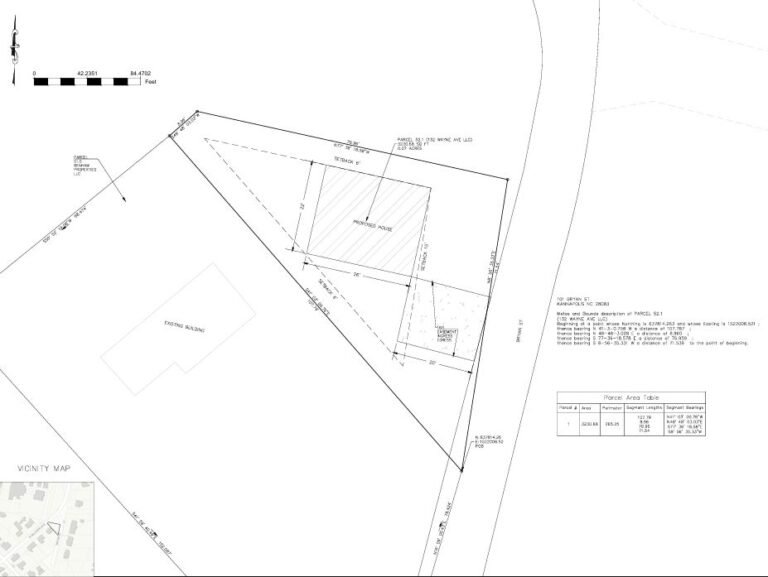
- Property Lines
- Lot Dimensions
- Primary Structure Roofline
- North Arrow
- Scale Bar
- Parcel ID
- Enhanced Compliance for Permits
Standard Site Plan
$119
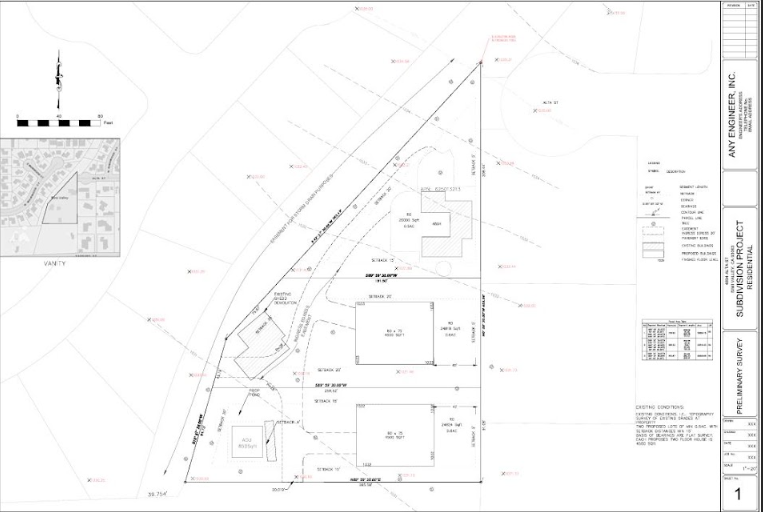
- Everything in Basic PLUS
- Driveway & Sidewalks
- Fences & Trees
- Swimming Pool
- Accessory Structures
- Shed, Deck, Patio
- Measurements Between Major Features
Gold Site Plan
$159

- Everything in Standard PLUS
- Landscaping Paths
- Shrubs
- Lawn
- Well & Septic System
- Parking Spaces
- Enhanced Compliance for Permits
Platinum Site Plan
$250

- Everything in Premium PLUS
- Additional New Structures
- Topographic Contour Lines
- Vicinity Map
- Graphic Scale
- DWG Source File
- Rush Order Available – Get It in Less Than 12 Hours!