
The permit checklist says "site plan required." The first contractor you call quotes you a boundary survey. The permit office website doesn't explain the difference. This page does — and it tells you exactly what your fence permit desk accepts, what it doesn't, and how to get the right drawing without overpaying for the wrong one.
The word “survey” gets dropped into fence permit conversations so often that most homeowners assume it’s what they need. A neighbor got a survey before putting up their fence. The fencing contractor mentioned needing “a survey of the property.” The permit application says “site plan or survey required.”
None of that means you need to hire a licensed land surveyor.
A boundary survey is a legal document. It establishes property lines with professional precision, carries a licensed surveyor’s stamp, and creates a recorded record of where your boundaries sit. It costs $500 to $2,000, takes weeks to schedule, and produces something that lasts for decades.
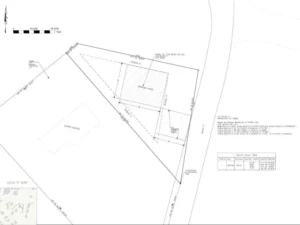
A fence permit site plan is a scaled drawing showing your lot, your existing structures, and where the proposed fence runs. It is not a legal document. It does not require a stamp. It costs $89 to $149 and is delivered in days. For the vast majority of residential fence permits in the United States, it is exactly what the permit office accepts — and exactly what a boundary survey is not designed to be.
The confusion between these two things costs homeowners real money and real time. This page ends that confusion.
What Your Fence Permit Office Is Actually Asking For
When a permit office says “site plan required” for a fence permit, they are asking for a drawing that lets a plan reviewer verify two things:
First: that the proposed fence is on your property, not your neighbor’s or the city’s right-of-way.
Second: that the fence placement, height, and location comply with your zoning district’s setback rules, height limits, and any sight-line clearances at corners.
Neither of those verifications requires a licensed survey. They require a scaled drawing with accurate lot dimensions, the right-of-way line shown, the proposed fence location dimensioned to the property line, and the fence height labeled. A non-certified drawing prepared from your parcel’s recorded deed and county GIS data does all of that — without a surveyor’s stamp, without a field visit, and without a $1,500 bill.
Most permit offices that process residential fence permits are explicit about this — if you read their checklist carefully. Language like “site plan,” “plot plan,” “property sketch,” or “scaled drawing showing fence location” means non-certified. Language like “certified survey,” “boundary survey by a licensed surveyor,” or “recorded plat with surveyor’s seal” means something different. The second set of language is rare for residential fence permits. If you see it, call the permit office and confirm before ordering anything.
The Specific Situations Where a Licensed Survey IS Required for a Fence Permit
There are real scenarios where a non-certified site plan isn’t enough. Knowing them upfront prevents ordering the wrong thing.
Your Municipality Specifically Requires a Certified Survey
Some municipalities — not many, but some — do require a licensed surveyor’s stamp on a fence permit site plan. This is more common in older East Coast cities, high-density urban areas, and jurisdictions with active boundary dispute histories where the permit office doesn’t want to take any risk on unverified property lines.
If your permit checklist specifically says “certified survey,” “surveyor’s stamp required,” or “boundary survey by licensed professional,” that requirement is real. A non-certified site plan won’t clear review there.
How to confirm: call the permit office directly and ask: “For a residential fence permit, do you require a site plan stamped by a licensed surveyor, or will a non-certified scaled drawing suffice?” Most clerks will answer that question in under a minute.
There Is an Active Boundary Dispute With a Neighbor
If where your property line sits is genuinely unclear — contested by a neighbor, unresolved from a prior sale, or in conflict with a neighbor’s existing fence placement — a non-certified site plan drawn from county records may show a boundary that doesn’t match what’s physically on the ground. In that scenario, a licensed survey establishes the legal boundary before you build anything permanent next to or on it.
You Have No Prior Survey and the Lot Is Irregular or Subdivided From a Larger Parcel
Properties subdivided from larger agricultural tracts, irregular lots in older rural subdivisions, and parcels where the deed description doesn’t clearly close can have genuine ambiguity in where the boundary lines sit. For these, a licensed survey isn’t just a permit requirement — it’s protection against building a fence that turns out to be on someone else’s land.
The Fence Is in a Location That Will Be Legally Disputed
Building a fence on or very close to a property line in a neighborhood with a history of boundary disputes is a different risk profile than building one in the middle of your rear yard. If the exact placement of the fence has any chance of becoming a legal matter — and you’re in a contentious neighborhood situation — a survey creates a legal record. A site plan doesn’t.
The Test: How to Read Your Fence Permit Checklist
Download your municipality’s fence permit application from their website. Find the site plan or drawing requirement. Then apply this reading:
If it says any of these → non-certified site plan is what you need:
- “Site plan”
- “Plot plan”
- “Property sketch”
- “Scaled drawing”
- “Location drawing”
- “Property diagram showing fence location”
- “Site plan or survey”
If it says any of these → call the permit office before ordering anything:
- “Certified survey”
- “Boundary survey”
- “Licensed surveyor”
- “Surveyor’s stamp or seal”
- “ALTA survey”
- “Recorded plat”
The “site plan or survey” phrasing is the most common source of confusion — it sounds like either works. In practice, for a fence permit, it means either the scaled drawing or a survey will satisfy the requirement. The non-certified site plan is the faster and significantly cheaper of the two options that both work.
What a Non-Certified Fence Permit Site Plan Covers
A non-certified site plan prepared from your parcel data covers everything a fence permit plan review verifies — without the legal certification a licensed survey provides and without the cost that comes with it.
What’s included in a done-for-you fence permit site plan:
- Lot boundaries drawn from the recorded deed — not estimated from a satellite image
- Right-of-way line shown and dimensioned — the line a fence can’t cross that’s separate from the property line in most front yards
- Proposed fence location at correct scale, dimensioned to the nearest property line
- Existing structures shown — house footprint, detached buildings, driveways
- Setback lines per your zoning district
- Recorded easements checked and shown where they affect fence placement
- Corner lot sight-line triangle where required
- Fence height labeled
- North arrow, scale bar, address, parcel number
What it is not: a legal document. It does not establish property lines with legal precision. It does not carry a professional stamp. It does not substitute for a boundary survey in contexts that require one — property sales, title insurance, subdivision platting, or boundary dispute resolution.
For a fence permit desk that accepts non-certified drawings — which is most of them — it is exactly what’s needed.
Side-by-Side: What You Get With Each Option
| Licensed Boundary Survey | Non-Certified Site Plan | |
|---|---|---|
| Cost | $500–$2,000+ | $89–$149 |
| Turnaround | 2–6 weeks | 24 Hr |
| Stamped by licensed professional | Yes | No |
| Legal document | Yes | No |
| Accepted for most residential fence permits | Yes | Yes |
| Required for property sales / title | Yes | No |
| Establishes boundary lines legally | Yes | No |
| What fence permit offices usually ask for | Rarely | Most of the time |
What Happens If You Order the Wrong One
If you order a survey when a site plan was sufficient: You’ve spent $500–$2,000 more than necessary and waited weeks longer than needed. The fence permit still gets approved — a survey satisfies a site plan requirement — but the overspend was real and the delay was real.
If you order a non-certified site plan when a survey was required: The plan gets rejected at plan review. You lose the time in the submission queue. You then need to order a survey, which adds weeks. The double cost and double delay is the outcome of not confirming the requirement before ordering.
The confirmation step is one phone call or one look at the permit checklist. It takes two minutes. Do it before ordering either.
Pricing
Fence Permit Site Plan — $89 Basic interior residential lot. Non-certified, permit-ready for municipalities that accept non-certified scaled drawings for fence permits. PDF delivered in [insert turnaround].
Corner Lot Fence Permit Site Plan — $119 Two street frontages, sight-line triangle, multiple setback zones.
Not sure which one you need? Send us your permit checklist and we’ll tell you whether a non-certified site plan is what your permit office accepts — before you order anything.
Frequently Asked Questions
A: In most U.S. municipalities for a standard residential fence permit, no. Most permit offices accept a non-certified scaled site plan showing lot boundaries, setbacks, right-of-way line, and proposed fence location. A licensed survey is required when the checklist specifically says “certified survey” or “surveyor’s stamp” — language that is uncommon for residential fence permits.
A: A licensed boundary survey is a legal document establishing property lines with professional certification. A site plan is a scaled drawing showing compliance with permit requirements. For a fence permit, most offices want the drawing — not the legal document. A survey satisfies a site plan requirement, but costs significantly more and takes far longer to obtain.
A: Sometimes. If the prior survey is recent, shows current structures, and clearly shows the right-of-way line and any recorded easements, some permit offices accept it with the proposed fence location marked on it. Call your permit office and ask specifically whether a prior survey with the fence marked on it satisfies their site plan requirement.
A: The non-certified site plan. Both satisfy the requirement in that phrasing, and the site plan costs a fraction of the survey and takes a fraction of the time. The survey is the more expensive option that still only satisfies the same requirement.
A: Your recorded deed contains the legal description of your property boundary. County GIS data shows the mapped parcel boundary. For most fence permit purposes, the county GIS boundary is sufficient. If you genuinely don’t know where your line sits — because there’s no prior survey, the lot is irregular, or there’s a neighbor dispute — that’s the scenario where a licensed survey is worth the cost regardless of the permit requirement.
A: Non-certified means the drawing is not prepared by or stamped by a licensed land surveyor or professional engineer. It’s a drafting document, not a legal document. For permit types that accept non-certified drawings — which includes most residential fence, shed, pool, and deck permits — non-certified is exactly what the permit desk is asking for. MySitePlan, GetASitePlan, and most residential site plan services operate in this same category.
A: Send us the correction note. We revise the plan to address whatever the reviewer flagged. Unilimited revision if City checker aks for resubmisions with corrections]
Send Us Your Checklist First — We’ll Confirm What You Need [email protected]